


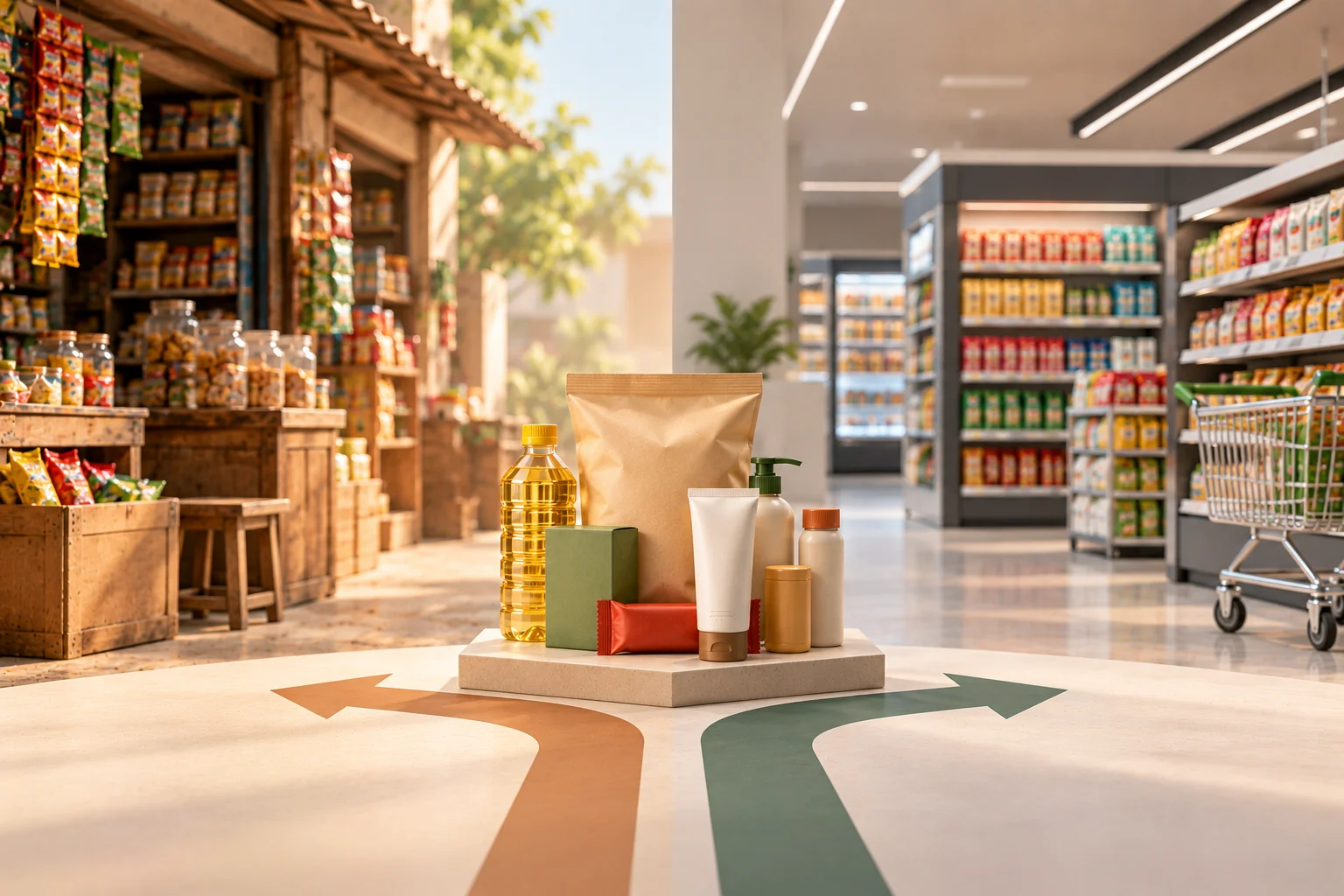
General Trade vs Modern Trade is a key decision for FMCG brands in India, as each channel requires a different approach to distribution, investment, retail visibility and growth. General trade is India’s traditional retail network of kirana and small neighbourhood stores, served through distributors and wholesalers, while modern trade means organised retail such as supermarket and hypermarket chains. Every FMCG brand has to decide which to build first, because each needs different money, people and marketing. This guide compares general trade and modern trade side by side and explains how a new or growing brand can decide where to start.
Key takeaways (The TL;DR)
- General trade covers kirana and small stores reached through distributors, while modern trade covers organised chains with centralised buying and shelf space.
- Redseer estimates that around 85 to 90 percent of mass grocery retail in India is still driven by traditional trade, with 13 to 14 million kirana stores, so general trade remains central to reach.
- Modern trade offers visibility, brand building and data, but needs larger baskets and steady footfall to work, and usually comes with higher overheads.
- Most brands do best by starting in one or two clusters, proving sales there and then adding channels in phases, including quick commerce and marketplaces.
General Trade vs Modern Trade at a Glance
| Factor | General trade | Modern trade |
| What it is | Kirana, provision and small neighbourhood stores | Organised supermarket, hypermarket and chain retail |
| How you reach it | Through distributors, wholesalers and field sales teams | Through direct listings with chain buyers, or modern trade distributors |
| Reach | Very wide, down to small towns and local lanes | Concentrated in cities and larger towns |
| Cost to start | Distributor margins, field team and trade schemes | Listing, promotions and supply terms that vary by chain |
| Shelf and brand control | Limited, varies store by store | Stronger, with planned shelves and in-store promotion |
| Data | Often limited without a distributor system | Chains may share sales data |
| Best for | Everyday, high-frequency, price-sensitive products | Premium, new or higher-basket products, and brand building |
The terms vary between chains and distributors, so treat the table as a general guide and check actual terms before you commit.
Why General Trade Still Matters
A Redseer published in March 2026 says that around 85 to 90 percent of mass grocery retail in India is still driven by traditional trade, and estimates 13 to 14 million kirana stores across the country. It also notes that kiranas have low fixed costs, fast stock turns and informal credit that support loyalty and repeat purchases, and that organised retail and quick commerce are growing from a much smaller base. The report expects formats to coexist and not replace each other. In practice, a brand that ignores general trade may be ignoring most of the market.
What Modern Trade Does Well
Modern trade gives a brand a clear shelf position, space for promotions and a more controlled environment for presenting the product. It reaches shoppers who plan larger baskets, and chains may share sales data that helps with planning. Redseer notes that modern trade carries higher overheads and needs larger baskets and steady footfall to hold margins, which is why a brand needs enough volume and enough working capital to make it pay.
Where Should an FMCG Brand Start?
There is no single rule, but the following guide covers common situations.
| Your situation | A sensible starting point | Why |
| New or premium product with a story to tell | Modern trade and online in a few metros | Shelf visibility and shopper trust help a new brand build proof |
| Everyday, low-price, high-frequency product | General trade in one or two dense clusters | Reach and repeat purchase come from many small outlets |
| Limited cash and a small team | One city or cluster, one or two channels | Focus keeps costs and complexity under control |
| Strong brand with proven demand | Both channels, added in phases | Use data from the first channel to plan the second |
A Phased Approach That Works for Most Brands
- Phase 1: choose one or two clusters, such as a city or a group of neighbourhoods, and prove sales and repeat purchase there.
- Phase 2: add distributors and field coverage in nearby areas, using what you learned about pricing, schemes and best-selling packs.
- Phase 3: add modern trade chains once you have steady supply, a clear price ladder and promotion budgets.
- Phase 4: use online channels, including marketplaces and quick commerce, to reach dense urban areas and build reviews and visibility.
Where Online and Quick Commerce Fit
Online and quick commerce are a third route that complements the other two. According to Redseer, quick commerce and ecommerce work best in dense urban micro-markets, while penetration is uneven in Tier 2 and Tier 3 areas where kiranas still dominate top-up purchases. For many brands, Blinkit, Zepto, Swiggy Instamart, Amazon Now, Flipkart Minutes and BigBasket are a way to build visibility and proof in cities while general trade carries volume elsewhere. Each platform needs its own stock planning and advertising.
The Marketing Each Channel Needs
| Channel | What marketing should do | Examples |
| General trade | Build pull so stores stock and shoppers ask for the product | Retail visibility, trade schemes, local activations, distributor engagement |
| Modern trade | Win shelf space and drive sales on the shelf | Shopper marketing, in-store promotions, display and planogram support |
| Online and quick commerce | Win search and category visibility | Listings, ads, ratings, stock availability by pin code |
Common Mistakes
- Launching everywhere at once and spreading stock, people and budget too thin.
- Choosing a channel because competitors are there, not because your product fits it.
- Pushing stock into distributors without creating shopper demand.
- Treating modern trade as a way to brand-build without the volume and working capital to support it.
- Running online ads where the product is out of stock or not available at the shopper’s pin code.
Where AKOI Fits
AKOI works with FMCG and D2C brands on retail marketing and quick commerce and marketplace marketing, helping a brand turn its channel choices into visibility and sales. If you are deciding how general trade, modern trade and online should fit together, we can help you think through where marketing effort will matter most in each.
Frequently Asked Questions
What is general trade in FMCG?
General trade is the traditional retail network of kirana and small stores, usually served through distributors and wholesalers rather than direct from the brand.
What is modern trade in FMCG?
Modern trade means organised retail such as supermarket and hypermarket chains, where a central team buys products and manages shelf space.
What is the difference between general trade and modern trade?
General trade is wide, fragmented and distributor-led. Modern trade is concentrated, structured and offers more shelf control, but typically comes with higher overheads and supply terms.
Should a new FMCG brand start with general trade or modern trade?
It depends on the product and the budget. Everyday, low-price products often start in general trade clusters, while premium or new products may start in modern trade and online in a few metros. Prove sales in one area first.
Do kirana stores still matter in 2026?
Yes. Redseer estimates that traditional trade still drives around 85 to 90 percent of mass grocery retail in India, with 13 to 14 million kirana stores.
Where does quick commerce fit?
Quick commerce is a third route that works best in dense cities. Many brands use it to build visibility and proof while general trade provides reach in other areas.