


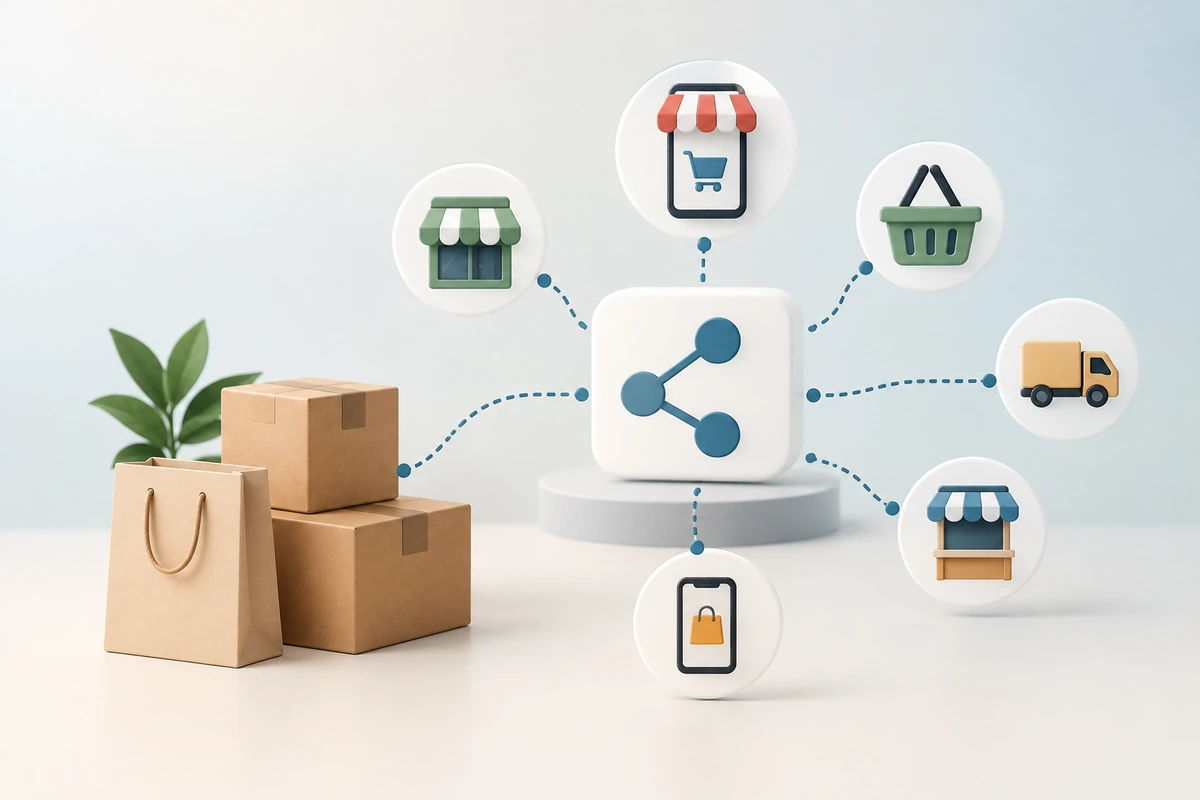
ONDC, the Open Network for Digital Commerce, is often explained the same way: think of it as UPI, but for ecommerce instead of payments. Rather than a single app controlling discovery, checkout, and logistics the way Amazon or Flipkart does, ONDC is a government-backed open protocol that lets any buyer app, seller app, and logistics provider interoperate on shared infrastructure. For D2C brands, the appeal is straightforward: commissions on ONDC are typically capped in the roughly 3 to 5 percent range, compared to 15 to 30 percent on traditional marketplaces and 18 to 35 percent on quick commerce once listing fees and ad spend are added in. That gap alone is why more D2C brands are taking a serious look at the network in 2026, even if it isn’t a replacement for the reach and speed of the bigger platforms.
Key takeaways (The TL;DR)
- ONDC is an open protocol, not a single shopping app, connecting independent buyer apps, seller apps, and logistics providers the same way UPI connects different banking apps for payments.
- Commissions on ONDC are typically capped around 3 to 5 percent, well below the 15 to 30 percent charged by traditional marketplaces and the 18 to 35 percent quick commerce can consume once listing fees and mandatory ad spend are included.
- By 2026, ONDC has grown to several hundred thousand onboarded sellers and service providers, over 100 active buyer apps, and coverage across 400-plus cities, expanding beyond retail into food delivery, mobility, financial services, and logistics.
- ONDC isn’t a substitute for quick commerce’s speed and conversion advantage, D2C brands reportedly see meaningfully higher GMV share on quick commerce, but its low commission structure makes it a valuable complementary channel for margin-conscious growth.
What ONDC Actually Is
ONDC unbundles the pieces that a single marketplace normally controls end to end. Buyer apps handle the customer-facing shopping experience. Seller apps onboard merchants, brands, and kirana stores, digitizing their catalogs and making them visible to any connected buyer app. Gateway nodes route a search query from a buyer app out to relevant seller apps in real time to fetch pricing and inventory. Logistics providers like Delhivery and Shiprocket plug in independently to fulfill orders, rather than being locked to whichever platform the sale happened on. The result is that a product listed once on a seller app can, in principle, be discovered and purchased through dozens of different buyer apps, without the brand needing a separate integration for each one.
The Real Draw for D2C Brands: Commission Structure
The economics are the clearest reason D2C brands are paying attention. On a ₹1,000 order, ONDC’s roughly 3 percent cap works out to about ₹30 in commission, compared to ₹150 to ₹300 on a traditional marketplace and ₹180 to ₹350 on quick commerce before listing fees and ad spend are even added. For a brand running on thin D2C margins, that difference compounds quickly across volume. It’s also, importantly, not a reason to abandon the higher-cost channels: quick commerce delivers reach and conversion that ONDC, still building buyer trust and app-level adoption, generally can’t match yet. The more useful framing is that ONDC adds a lower-cost discovery layer alongside existing channels, rather than competing to replace them outright.
How a D2C Brand Actually Onboards
Brands join ONDC through a seller-side application rather than ONDC itself, completing KYC with bank account details, GST registration, and business PAN, then listing products with pricing, stock levels, and images through that seller app’s dashboard. This process is often faster than onboarding on Amazon or Flipkart directly, since a brand is dealing with a single seller app’s requirements rather than a large marketplace’s full compliance and category-approval process. One detail worth building into that onboarding: because a listing becomes discoverable across every connected buyer app simultaneously, a well-optimized catalog entry effectively behaves like an SEO asset for the entire network, not just one storefront.
Where the Network Is Expanding Beyond Retail
ONDC has moved well past its original grocery and retail pilot. The network now spans food and beverage delivery, mobility (auto-rickshaw and taxi bookings through open apps rather than corporate aggregators), financial services, agriculture, and, more recently, a tourism vertical built with the Ministry of Tourism to verify provider credentials at the point of booking. For a D2C brand, this broader ecosystem matters less directly, but it signals that the underlying protocol is gaining real, sustained institutional backing rather than being a short-lived pilot.
How AKOI Approaches This
AKOI’s ecommerce marketplace marketing team helps D2C brands evaluate ONDC alongside their existing Amazon, Flipkart, and quick commerce presence, treating it as an additional lower-commission discovery channel rather than a wholesale replacement, and building catalog and pricing strategy that works across all of them consistently.
Conclusion
ONDC represents a genuine structural shift in how digital commerce works in India, even if its scale today is still modest next to Amazon, Flipkart, and quick commerce. For D2C brands, the commission savings are real and worth exploring, but the smarter approach is treating it as one channel in a broader stack rather than a shortcut around the platforms that still drive the bulk of online demand. ONDC’s own website is the best starting point for brands evaluating which seller apps and categories fit their business.
Frequently Asked Questions
Is ONDC a shopping app like Amazon or Flipkart?
No. ONDC is an open protocol connecting independent buyer apps, seller apps, and logistics providers, similar to how UPI connects different banking apps for payments, rather than a single unified shopping destination.
How much does it cost to sell on ONDC compared to Amazon or Flipkart?
ONDC commissions are typically capped around 3 to 5 percent, compared to roughly 15 to 30 percent on traditional marketplaces, making it considerably cheaper on a per-order basis, though it currently offers less reach and buyer traffic than the larger platforms.
How does a D2C brand get started on ONDC?
Brands join through a seller-side application, completing KYC with bank details, GST, and PAN, then listing products through that app’s dashboard, a process that’s often faster than onboarding directly on Amazon or Flipkart.
Should a D2C brand choose ONDC or quick commerce?
They serve different purposes rather than competing directly. Quick commerce currently delivers stronger reach and conversion for many D2C brands, while ONDC offers a significantly lower commission structure, making the two complementary rather than an either-or choice.
How big is ONDC in 2026?
By 2026, ONDC has grown to several hundred thousand onboarded sellers and service providers, over 100 active buyer apps, and operations across more than 400 cities, expanding well beyond its original retail and grocery pilot.
Does ONDC only cover retail and grocery?
No. The network has expanded into food and beverage delivery, mobility, financial services, agriculture, and tourism, alongside its original retail and grocery categories.