


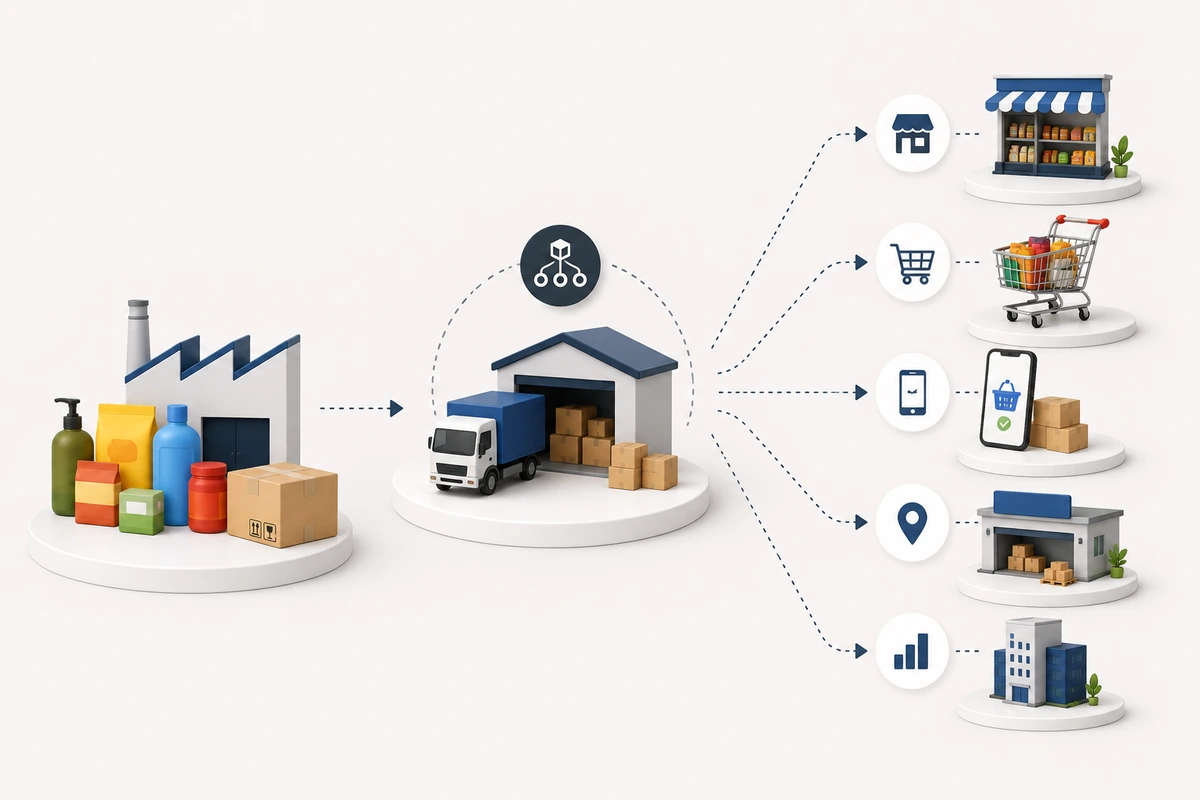
Retail distribution strategies for FMCG brands in India look very different in 2026 than they did even five years ago, mostly because the market itself has grown and split in new directions. India’s FMCG industry generated roughly ₹25 lakh crore (about $289 billion) in 2025, according to IBEF, and rural India has now outpaced urban demand growth for six consecutive quarters, with average rural basket sizes climbing from 5.8 items in 2022 to 9.3 items in 2024. Quick commerce gets most of the headlines, but IBEF pegs its current penetration at only around 7 percent of a roughly $45 billion addressable opportunity, which means the bulk of FMCG distribution strategy in India still has to be built around general trade and modern trade, not just the newest channel.
Key takeaways (The TL;DR)
- India’s FMCG market is now a genuine three-channel business, general trade, modern trade, and quick commerce, and a distribution strategy built around only one of them leaves real growth on the table.
- Rural India has outpaced urban demand growth for six straight quarters, with basket sizes rising sharply, making tier-2, tier-3, and tier-4 expansion one of the highest-leverage distribution moves available in 2026.
- Quick commerce still represents a small share, around 7 percent, of the total addressable FMCG opportunity per IBEF, so distributors and brands need it as one channel among several, not a replacement for general trade.
- Digitizing distributor operations with real-time data, and adding retailer-level value like credit and merchandising support, are now table-stakes moves rather than differentiators.
The Distribution Landscape FMCG Brands Are Actually Working With
General trade, the network of kirana stores, wholesalers, and local provision shops, still moves the overwhelming majority of FMCG volume in India, particularly in tier-2 and tier-3 markets where it accounts for more than 90 percent of sales. Modern trade owns a smaller but higher-value urban basket, and quick commerce, while its penetration remains modest against the total market, is growing fast and concentrated in exactly the metro categories that used to be reliable margin for distributors. A distribution strategy built for 2026 has to treat all three as connected parts of one plan, not compete against each other for the same budget.
1. Build a Genuine Three-Channel Strategy
The single biggest mistake FMCG brands make in 2026 is still treating general trade, modern trade, and quick commerce as separate initiatives run by separate teams with separate budgets. Each channel needs its own pack sizes, pricing logic, and promotional calendar, but they should be planned together, since a stockout or a pricing mismatch in one channel increasingly affects buyer trust and demand in the others.
2. Digitize Distributor Operations With a DMS
A Distribution Management System gives real-time visibility into secondary sales, stock levels, and retailer-level performance across a distributor network, replacing the delayed, spreadsheet-based reporting that still defines a lot of general trade operations. Brands that can see which retailers and territories are underperforming in near real time can act on it in weeks rather than discovering the gap at the next quarterly review.
3. Prioritize Tier-2, Tier-3, and Tier-4 Expansion
With rural demand outpacing urban growth for six straight quarters and basket sizes rising sharply, expanding distribution depth into smaller towns is one of the highest-leverage moves available right now. These markets carry less competitive pressure than saturated metro categories and are large enough in aggregate to matter, even though individual towns look small on their own.
4. Become a Fulfilment Partner for Quick Commerce, Not Just a Competitor to It
Rather than treating quick commerce purely as a threat to general trade margins, some distributors are positioning themselves as dark-store fulfilment or replenishment partners for quick commerce platforms, using their existing warehousing and logistics infrastructure to serve a channel they can’t easily out-compete on speed. This turns a competitive threat into an additional revenue stream built on assets the distributor already owns.
5. Invest in Retailer-Level Value, Not Just Margin
Kirana retailers increasingly choose distribution partners based on more than just margin, credit terms, merchandising support, and reliable, on-time replenishment matter just as much to a small retailer’s day-to-day business. Distributors and brands that invest in these retailer-facing services build loyalty that’s harder for a purely price-competitive rival to displace.
6. Diversify Pack Sizes and Categories by Channel
A single national pack-size strategy increasingly underperforms a channel-specific one. General trade and rural markets often favor smaller, lower-priced sachets and packs suited to frequent, small-basket purchases, while quick commerce rewards different pack architecture entirely, tuned to its own lower average order value. Brands running one pack strategy across every channel are usually leaving conversion on the table in at least one of them.
7. Build Retail Analytics Into the Distribution Plan
Understanding which SKUs are moving, in which territories, and at what velocity, at the retailer level rather than just the distributor level, is what turns a distribution network from a fixed cost into a genuine growth lever. This kind of visibility is what makes the other strategies on this list actionable, without it, a DMS rollout or a tier-3 expansion push is running mostly on assumption rather than data.
How AKOI Approaches This
AKOI’s quick commerce and marketplace marketing team helps FMCG brands build the digital-channel piece of a broader distribution strategy, coordinating pricing, pack strategy, and fulfilment across Blinkit, Zepto, Swiggy Instamart, Amazon Now, Flipkart Minutes, and BigBasket, so the digital channels stay consistent with the brand’s wider general trade and modern trade distribution plan rather than working against it.
Conclusion
The FMCG brands winning on distribution in 2026 aren’t the ones betting everything on quick commerce or clinging entirely to general trade, they’re the ones building a genuinely coordinated three-channel strategy. IBEF’s ongoing FMCG industry analysis is a useful resource for tracking how this channel mix keeps shifting. Getting distribution right in 2026 means treating general trade, modern trade, and quick commerce as one connected system, not three separate bets.
Frequently Asked Questions
Is general trade still important for FMCG brands in India?
Yes, significantly. General trade still moves more than 90 percent of FMCG volume in tier-2 and tier-3 markets, and remains the primary channel reaching India’s roughly 13 million kirana stores.
What is a Distribution Management System (DMS) in FMCG?
A DMS is software that gives brands and distributors real-time visibility into secondary sales, retailer-level stock, and territory performance, replacing delayed spreadsheet-based reporting with data that can be acted on quickly.
How big is quick commerce compared to the total FMCG market in India?
Quick commerce’s penetration is still relatively small against the total addressable FMCG market, estimated by IBEF at around 7 percent of a roughly $45 billion opportunity, though it’s growing quickly and concentrated in specific urban categories.
Should FMCG brands expand into tier-2 and tier-3 cities?
Many brands are finding real opportunity there, since rural demand has outpaced urban growth for six consecutive quarters and average basket sizes have risen sharply, while competitive pressure remains lower than in saturated metro categories.
Can distributors work with quick commerce platforms instead of competing against them?
Yes. Some distributors are becoming dark-store fulfilment or replenishment partners for quick commerce platforms, turning existing warehousing and logistics assets into an additional revenue stream rather than treating the channel purely as competition.
Do pack sizes need to differ across distribution channels?
Often yes. General trade and rural markets frequently favor smaller, lower-priced packs suited to frequent purchases, while quick commerce has its own distinct pack and pricing logic tied to its lower average order value.