


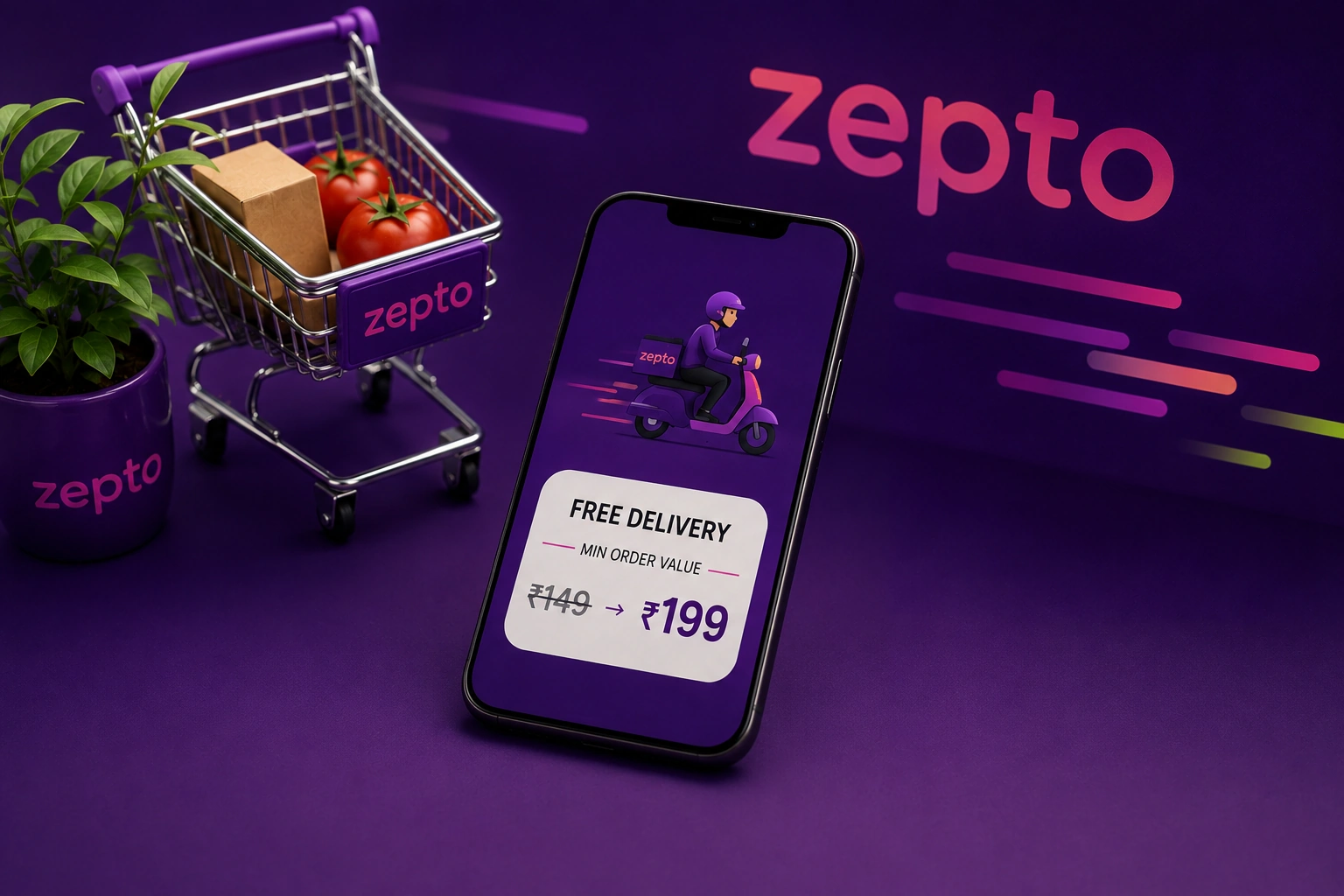
Zepto’s minimum order value for free delivery has increased from ₹149 to ₹199, bringing the platform’s standard free-delivery threshold broadly in line with Blinkit and Swiggy Instamart. During high-demand periods, Zepto’s threshold can climb further, up to ₹299, according to multiple reports. It is the second such hike in under a year: Zepto had already moved the threshold from ₹99 to ₹149 in January 2026, after briefly cutting it to ₹99 in late 2025. For shoppers, smaller baskets now cost more. For brands selling on quick commerce, it changes the math on how orders get placed.
Key takeaways (The TL;DR)
- Zepto has raised its free-delivery minimum order value from ₹149 to ₹199 in normal hours, rising to as much as ₹299 during high-demand periods.
- This brings Zepto in line with Blinkit and Swiggy Instamart, both of which already require a ₹199 minimum order for free delivery in most cities.
- It is Zepto’s second minimum order value hike in under a year, following a move from ₹99 to ₹149 in January 2026, as the company works toward stronger unit economics ahead of a planned IPO.
- For brands, a higher threshold usually means fewer, larger baskets, which makes assortment, bundling, and platform-specific pricing more important than they were when smaller add-on orders were common.
What Actually Changed
Zepto customers previously got free delivery on any order above ₹149. That threshold is now ₹199 during regular hours, a roughly 34 percent jump, and multiple reports note it can rise as high as ₹299 during peak demand windows or in high-density pincodes. Orders that fall below the threshold are charged a delivery fee, which pushes shoppers to either add more items or accept the extra cost. This is not framed as a one-off adjustment. It follows a similar hike from ₹99 to ₹149 earlier in 2026, meaning the free-delivery floor has effectively doubled within the year.
Why Zepto Made This Move
Quick commerce has spent the last two years proving demand exists. The harder problem, and the one investors are now pricing in, is proving the model can be profitable at that demand level. Delivering small baskets in under 10 minutes is expensive: dark-store rent, rider payouts, and packaging costs don’t scale down just because the order is small. Raising the free-delivery floor is one of the more direct levers a platform has to nudge average order value upward without touching product pricing itself. It also matters that Zepto received SEBI approval for its IPO earlier this year, which puts a sharper spotlight on order-level profitability than the company faced during its earlier growth-at-any-cost phase.
How It Compares Across the Big Three
With this change, Blinkit, Swiggy Instamart, and Zepto are now broadly aligned on free-delivery thresholds, all sitting around ₹199 in normal conditions. That convergence is worth noting on its own. When category leaders move in the same direction within months of each other, it usually signals a shared read on unit economics rather than a competitive jab at each other, since none of them benefits from being meaningfully cheaper on delivery while the others hold the line.
What This Means for Brands Selling on Quick Commerce
For brands, a higher free-delivery threshold changes shopper behavior in fairly predictable ways. Basket sizes tend to grow, since shoppers add a second or third item to clear the free-delivery line rather than pay a fee on a single small purchase. That is an opportunity for brands with a natural bundling story (a refill pack alongside a primary product, a smaller companion SKU) and a risk for brands whose entire catalog sits at a low price point, since single-SKU orders under the new threshold now carry an extra cost that can push price-sensitive shoppers toward a competitor’s cart instead.
This is also a moment to revisit platform-specific pricing and pack sizes rather than running an identical strategy across Blinkit, Zepto, Swiggy Instamart, Amazon Now, Flipkart Minutes, and BigBasket. A ₹149 SKU that used to clear free delivery on its own now sits just under the new ₹199 floor on three major platforms at once, which is exactly the kind of shift that should trigger a pricing and assortment review, not a wait-and-see approach.
How AKOI Helps Brands Navigate This
AKOI’s quick commerce marketing team tracks exactly this kind of platform-level policy shift across Blinkit, Zepto, Swiggy Instamart, Amazon Now, Flipkart Minutes, and BigBasket, and adjusts pricing, bundling, and category ad spend for client brands as thresholds and platform economics change. A minimum order value hike like this one is the kind of detail that gets missed in a monthly reporting cycle but shows up immediately in basket-size and conversion data if you’re watching it in real time.
The Bigger Picture
Quick commerce in India is moving from a growth-at-any-cost phase into one where order-level profitability matters as much as order volume, a shift Redseer’s recent quick commerce coverage has also flagged as the sector’s defining question for 2026. Zepto’s minimum order value hike is a small, specific example of that larger shift. It won’t be the last one. Brands that treat these threshold and fee changes as routine platform housekeeping will keep losing small-basket sales to competitors who adjust their pack sizes and pricing first.
Frequently Asked Questions
What is Zepto’s new minimum order value for free delivery?
Zepto’s minimum order value for free delivery is now ₹199 during normal hours, up from ₹149. During periods of high demand, it can rise to as much as ₹299.
Why did Zepto increase its free delivery minimum order value?
Reports point to the quick commerce sector’s broader push to improve order-level profitability and unit economics, along with Zepto’s approaching IPO, which puts more scrutiny on the company’s margins.
Is Zepto’s free delivery threshold the same as Blinkit and Swiggy Instamart?
Yes, this change brings Zepto’s ₹199 threshold roughly in line with Blinkit and Swiggy Instamart, both of which already require a similar minimum order value for free delivery in most markets.
How does a higher minimum order value affect brands on quick commerce?
It typically pushes shoppers toward larger baskets to avoid a delivery fee, which can benefit brands with bundling options and pressure single-SKU, low-price-point products that now fall under the new threshold.
Should brands change their pricing because of this?
It’s worth reviewing pack sizes and platform-specific pricing rather than assuming nothing has changed, especially for SKUs priced just under the new ₹199 floor, since those are the orders most likely to lose free delivery.
Has Zepto raised its free delivery threshold before?
Yes. Zepto raised the threshold from ₹99 to ₹149 in January 2026, after briefly lowering it to ₹99 in late 2025, meaning this is its second increase within the year.