


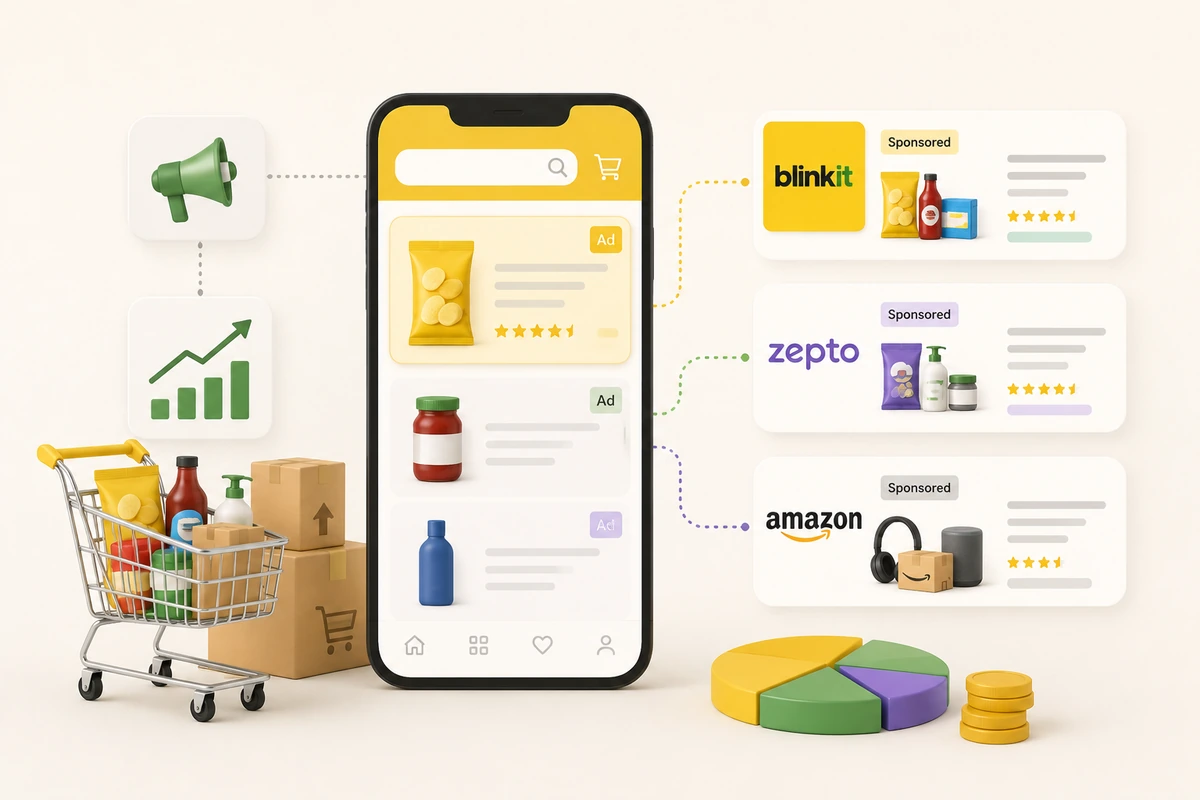
Retail media advertising is what happens when a retailer stops being just a place you sell products and becomes a place you also buy ads, and in India’s quick commerce sector, it has grown into a genuinely large business in its own right. Combined advertising revenue for Blinkit, Zepto, and Swiggy Instamart is estimated to touch roughly ₹4,900 crore by the end of 2026, up from around ₹3,000 crore in 2025, according to Datum Intelligence. Zepto’s own IPO filing disclosed advertising revenue surging 151 percent year over year to ₹1,636 crore in FY26, now accounting for more than 7 percent of its operating revenue. For brands, this means sponsored placement on these platforms is no longer a nice-to-have add-on, it’s becoming as central to visibility as organic listing quality.
Key takeaways (The TL;DR)
- Retail media is the advertising business a retailer builds on top of its own store, selling sponsored placements and audience data to the brands already selling there, and combined ad revenue for Blinkit, Zepto, and Instamart is projected to reach roughly ₹4,900 crore by the end of 2026.
- Zepto’s IPO filing disclosed advertising revenue growing 151 percent year over year to ₹1,636 crore in FY26, now over 7 percent of its operating revenue, showing how central ads have become to platform profitability.
- Sponsored Products, Sponsored Brands, and Display are the core ad formats across Blinkit, Zepto, and Amazon, mirroring the same auction-based, keyword-targeted model across all three.
- Unlike Amazon, quick commerce ads only serve where inventory is actually stocked, so a campaign’s real reach is limited by dark-store availability in specific pincodes, not just budget or bid.
What Retail Media Advertising Actually Is
A retail media network is the advertising platform a retailer builds on top of its own store, selling sponsored placements, display inventory, and access to first-party purchase data to the brands already selling on that platform. Amazon Ads was one of the first and largest examples of this model globally, alongside Walmart Connect and Instacart Ads, and Blinkit, Zepto, Flipkart, and Swiggy Instamart have all built their own versions in India. The pitch to brands is straightforward: reach shoppers at the exact moment they’re deciding what to buy, using data the retailer has that nobody else does.
How Big This Has Gotten in India
The scale here has grown quickly. Blinkit and Zepto both crossed ₹1,000 crore in annual advertising revenue by FY25, and industry estimates put their combined ad business, alongside Swiggy Instamart, at close to ₹4,900 crore by the end of 2026. Blinkit hasn’t broken out its advertising revenue as a standalone line, but its parent company’s management has repeatedly noted that quick commerce already generates more ad income as a share of order value than food delivery does, which says a lot about where platform priorities are heading. For brands, this growth is a signal that competition for sponsored placement is only going to get more expensive over time, not less.
The Core Ad Formats: Sponsored Products, Sponsored Brands, and Display
Blinkit, Zepto, and Amazon all run a similar three-format structure. Sponsored Product ads place an individual listing higher in search or category results. Sponsored Brand ads give a brand a more prominent, branded placement, often at the top of a category page. Display ads target shoppers based on browsing behavior rather than a specific search term. Reported CPCs on quick commerce platforms tend to run in a roughly ₹2 to ₹15 range, with ROAS benchmarks generally landing between 4x and 8x for established SKUs and 1.5x to 3x for new launches still building a sales history.
What Makes Quick Commerce Retail Media Different From Amazon
The single biggest structural difference is geography. An Amazon Sponsored Products campaign can serve a listing to a shopper anywhere in the country the product ships to. A Blinkit or Zepto campaign only serves where the product is actually stocked in a nearby dark store, so a brand’s real ad reach is capped by its own inventory footprint, not just its budget. This means ramping up ad spend without first confirming dark-store coverage in the target pincodes usually just means paying for impressions that can’t convert, since the platform won’t show a sponsored listing for a product it can’t deliver.
The Discipline Most Brands Skip: Watching Paid vs. Organic Share of Voice
One of the more useful diagnostics in retail media is tracking how much of a brand’s visibility on a given search term is paid versus organic, and watching that ratio over time. If paid share of voice climbs while organic share falls, it usually means rising ad spend is masking a listing quality problem rather than solving it, since the brand is having to pay for visibility it used to earn for free. Brands that only look at ROAS in isolation, without checking whether they’re becoming more dependent on paid placement over time, often miss this shift until the ad budget needed to maintain the same visibility has grown substantially.
How AKOI Approaches This
AKOI’s quick commerce and marketplace marketing team manages sponsored campaigns across Blinkit, Zepto, Swiggy Instamart, Amazon Now, Flipkart Minutes, and BigBasket alongside inventory and dark-store coverage, so ad spend is directed only toward pincodes where the product can actually be delivered, rather than paying for reach that can’t convert.
Conclusion
Retail media has moved from a supplementary tactic to a core part of how brands win visibility on Blinkit, Zepto, and Amazon, and the numbers behind that shift are large enough that ignoring it isn’t really an option anymore for brands competing in these categories. The IAB’s retail and commerce media standards are a useful reference for understanding how the industry is standardizing measurement across this fast-growing channel. Getting retail media right means treating it as inventory-aware advertising, not a version of Google or Meta ads run inside a shopping app.
Frequently Asked Questions
What is retail media advertising?
Retail media advertising is the advertising business a retailer builds on top of its own platform, selling sponsored placements, display ads, and access to first-party shopper data to the brands already selling there, as seen with Amazon Ads, Blinkit, and Zepto.
How big is retail media on Indian quick commerce platforms?
Combined advertising revenue for Blinkit, Zepto, and Swiggy Instamart is estimated to reach roughly ₹4,900 crore by the end of 2026, and Zepto’s own IPO filing disclosed ad revenue growing 151 percent year over year to ₹1,636 crore in FY26.
What ad formats are available on Blinkit and Zepto?
Both platforms offer Sponsored Product ads for individual listings, Sponsored Brand ads for more prominent branded placements, and Display ads targeting shoppers based on browsing behavior, closely mirroring Amazon’s ad format structure.
Why doesn’t my quick commerce ad campaign reach as many people as expected?
Quick commerce ads only serve where the product is actually stocked in a nearby dark store, so a campaign’s reach is capped by inventory coverage in specific pincodes, unlike Amazon, where a listing can be advertised nationally regardless of local stock.
What is a good ROAS benchmark for quick commerce advertising?
Reported benchmarks generally fall between 4x and 8x for established SKUs with sales history, and 1.5x to 3x for new launches that are still building organic traction and reviews.
How do I know if I’m over-relying on paid ads instead of organic visibility?
Track paid versus organic share of voice on your priority search terms over time. If paid share is climbing while organic share falls, rising ad spend may be compensating for a declining listing quality or ranking issue rather than driving incremental growth.