


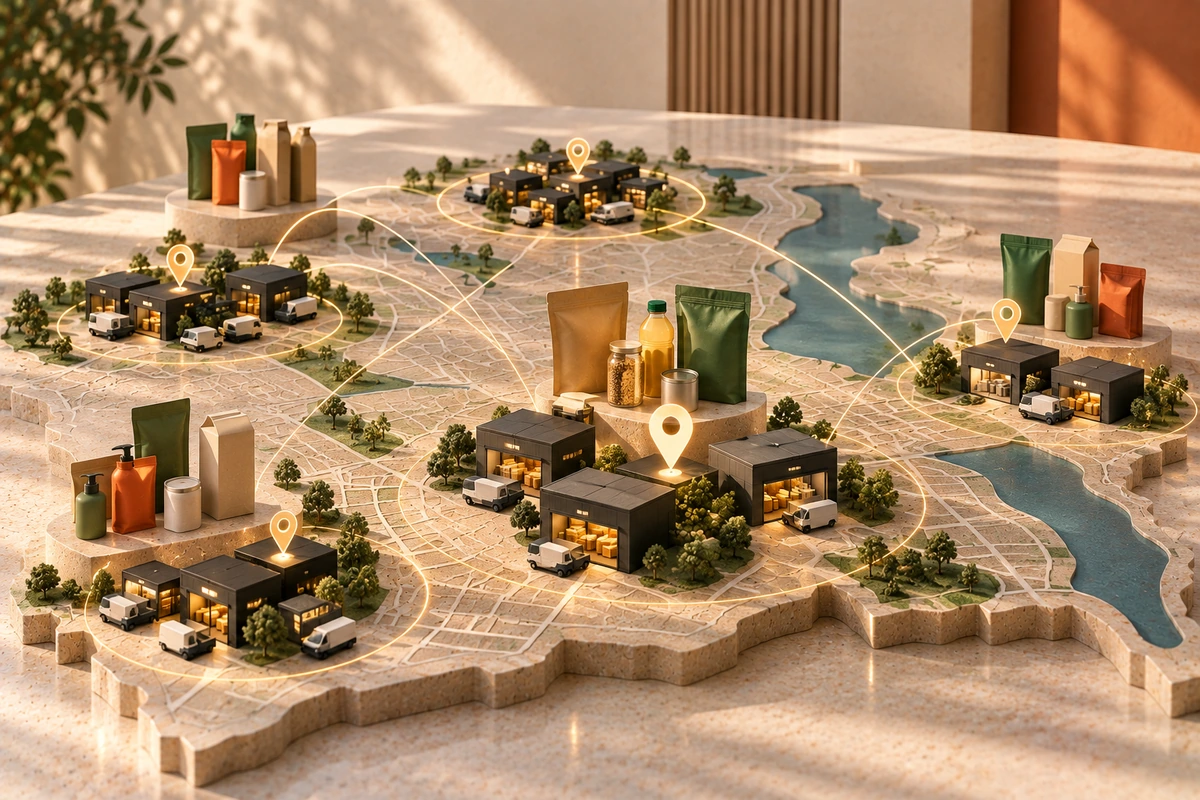
Quick commerce dark store density now decides where FMCG brands should launch first, because a product can only sell where a dark store is close enough to deliver it in minutes. Dark stores are small local warehouses that serve a few kilometres around them, so the cities and pincodes with the most of them offer the most reachable shoppers per listing. With platforms like Blinkit, Zepto, Swiggy Instamart, Flipkart Minutes, Amazon Now and BigBasket all expanding, the map is changing fast, and a launch plan built on last year’s city list can put stock in the wrong places.
Key takeaways (The TL;DR)
- A CLSA count reported in August 2026 put five major platforms at about 3,536 dark stores across India’s top 10 cities, with Bengaluru, Delhi, Hyderabad, Mumbai and Chennai holding the largest networks.
- Bernstein estimates roughly 5,700 to 6,000 dark stores nationally as of April 2026, serving about 2,600 pincodes, and says metro quick commerce is now largely mature while platforms push into smaller cities.
- FMCG brands usually do best launching first in the densest metro clusters where they already have distribution, because more stores per area means more shoppers reached and faster sell-through.
- Tier 2 and tier 3 cities are the next phase, but should be tested city by city, since store potential there is still unproven according to Bernstein.
Why Dark Store Density Matters for a Launch
A quick commerce listing is only visible to shoppers whose pincode is served by a dark store that stocks the product. More dark stores in an area means a larger share of the population can see and order your brand, and more stores that can hold stock close to demand. For a new FMCG product, that matters twice. First, awareness: shoppers can only discover you where you are available. Second, performance: platforms judge new products by how quickly they sell, and low sell-through in a store can lead to reduced visibility or delisting, so launching where demand is dense gives a product the best chance to prove itself.
What the Latest Numbers Show
A CLSA report, as reported in August 2026, counted 3,536 dark stores across five platforms in the top 10 cities. Blinkit led with 969, followed by Zepto with 828, Flipkart Minutes with 627, Swiggy Instamart with 615 and BigBasket with 497. Amazon and JioMart were not included. Separately, Bernstein counted roughly 5,700 to 6,000 dark stores nationally as of April 2026, serving about 2,600 pincodes and around 230 million people, or about 17 percent of India’s population. The counts differ because they cover different cities, dates and platforms, but both show the same picture: the network is large, concentrated in a handful of metros and growing outward.
| City | Dark stores, all platforms (CLSA, Aug 2026) | What it suggests for a launch |
| Bengaluru | 735 | Largest network, a natural first city if your distribution is ready |
| Delhi and Gurgaon | 531 and 225 | Strong cluster, plan Delhi NCR as one launch zone |
| Hyderabad | 484 | Dense network, a strong second wave |
| Mumbai | 372 | High demand, but plan stock by neighbourhood |
| Chennai | 365 | Large network, include in the core set for most categories |
| Pune | 293 | Good next-wave city with a growing network |
City totals combine all platforms, and the density of any single platform in a city can differ. Check platform-level coverage before committing stock.
A Phased Launch Plan for FMCG Brands
Phase 1: Start in two or three dense clusters
Pick the cities where dark store density and your own distribution overlap, usually among the largest metros. Concentrating launch stock, listings and advertising in a few clusters builds sell-through faster than spreading thin across ten cities, and it keeps fill rate high, which protects your visibility.
Phase 2: Add the next metro wave once velocity is proven
When your launch SKUs are selling steadily and fill rate is stable, add the next group of dense cities, such as Hyderabad, Chennai and Pune. Use phase 1 sales data to decide which SKUs and pack sizes to carry.
Phase 3: Test tier 2 and tier 3 city by city
Platforms are expanding into smaller cities. Bernstein reported that Amazon plans to scale Amazon Now to 100 cities and that Flipkart has been adding stores in tier 2 and 3 cities since January 2026, while describing the potential there as still unproven. Treat these cities as tests, with small inventory commitments, pincode-level tracking and clear stop rules.
Think in Pincodes, Not Just Cities
Dark store density varies a lot inside a city. A brand can be well stocked in a city yet absent in the neighbourhoods where its target shoppers live. Track availability, fill rate and sales by pincode, and focus advertising on pincodes where you are in stock. Spending on ads for areas you cannot serve wastes budget and can hurt performance metrics.
Match Platform to City
Because each platform has its own strongest cities, a single national plan rarely fits all six. Blinkit and Zepto lead the CLSA count, while Flipkart Minutes and Amazon Now are growing quickly and may offer easier entry in cities where they are building up. Review platform strength city by city and prioritise accordingly.
How AKOI Helps FMCG Brands Plan Quick Commerce Launches
AKOI’s quick commerce marketing team plans launches across Blinkit, Zepto, Swiggy Instamart, Amazon Now, Flipkart Minutes and BigBasket with city and pincode-level targeting, inventory-aware advertising and catalogue setup, so launch budgets follow availability instead of running where the product cannot be delivered.
Conclusion
Launching on quick commerce is a map problem as much as a marketing one. Start where dark stores are densest and your distribution is strong, prove velocity, then widen to the next metros and test smaller cities carefully. Verify current platform coverage before committing stock, since the network is changing quickly. Redseer’s analysis of how quick commerce is scaling is a useful companion read on where growth is heading.
Frequently Asked Questions
What is dark store density in quick commerce?
It is how many dark stores serve a given area. More stores per area means more shoppers can receive a product within minutes, which matters for how many people can see and buy your brand.
Which Indian cities have the most quick commerce dark stores?
A CLSA count reported in August 2026 put Bengaluru first with 735 across five platforms in the top 10 cities, followed by Delhi with 531, Hyderabad with 484, Mumbai with 372 and Chennai with 365.
Which city should an FMCG brand launch in first on quick commerce?
Usually the dense metro where your distribution and stock are strongest, often Bengaluru, Delhi NCR or Hyderabad. The right choice depends on your category, platform mix and inventory.
Should FMCG brands launch in tier 2 and tier 3 cities on quick commerce?
As a later phase and city by city. Platforms are expanding there, but analysts describe the store potential as still unproven, so start with small tests.
How many dark stores are there in India?
Estimates vary by date and method. Bernstein counted roughly 5,700 to 6,000 across major platforms as of April 2026, while CLSA counted 3,536 across five platforms in the top 10 cities in August 2026.
Why does sell-through matter for a new quick commerce product?
Platforms favour products that sell quickly in each store, and slow-moving items can lose visibility or be delisted, so launching where demand is dense helps a new product prove itself.