


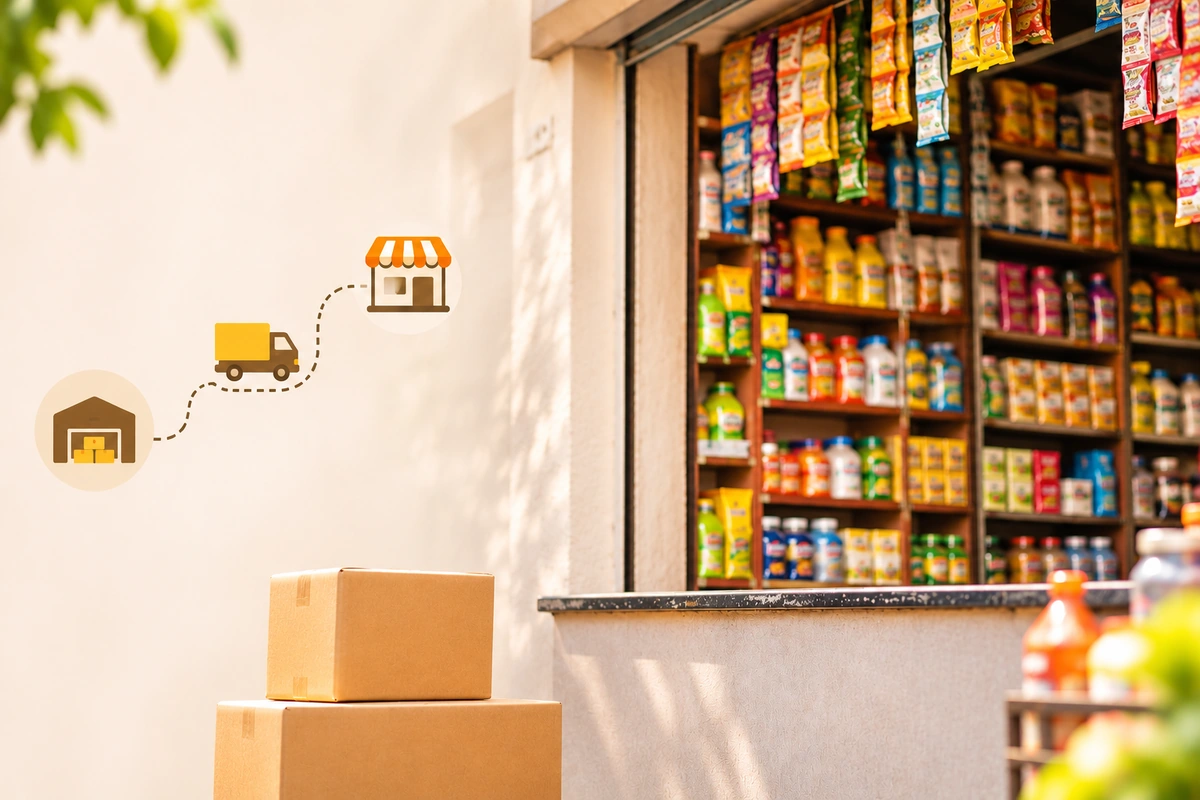
A kirana distribution strategy is the plan a brand uses to get its products onto the shelves of India’s neighbourhood stores in a way that repeats, pays back and can be measured. Many D2C and FMCG brands treat kiranas as either too hard or too obvious, and both views cost money. This guide sets out why kiranas still matter, how to choose where to start, how a distributor chain usually works, what to put in a retailer offer and how to keep your marketplace and quick commerce work in step with it. It is AKOI’s own analysis, using published research where it exists.
Key takeaways (The TL;DR)
- Redseer estimates kirana stores held about 91% of mass grocery in CY2025 and expects about 86% by CY2030, so they remain the main route to most households.
- NielsenIQ reports e-commerce at 7% of India’s FMCG sales in its Q2 2026 snapshot, so online is growing but is still a minority channel.
- Start with a few chosen cities or pin codes, one distributor model and a short list of products, then expand only when repeat orders prove demand.
- Align price, pack sizes and promotions across kiranas, marketplaces and quick commerce, or one channel will undercut the others.
Why a Kirana Distribution Strategy Still Matters
Redseer’s report on why mass grocery leans on kirana stores says kirana stores held about 91% share of mass grocery in CY2025 and are expected to hold about 86% by CY2030. It links this to neighbourhood reach, personalised service, trusted credit and small-ticket buying, and it describes kiranas as built for low average order values of INR 100 to 200. The page does not give a store count, so we do not quote one.
The other side of the picture is online growth. NielsenIQ’s India FMCG Quarterly Snapshot for Q2 2026 reports e-commerce at 7% of national FMCG sales in its Q2 2026 snapshot, with e-commerce and modern trade the main drivers of incremental growth and e-commerce strongest in urban markets. The snapshot does not give general trade or quick commerce figures, so treat both numbers as directional. Our reading: online builds visibility and data, kiranas build reach, and most brands eventually need both.
Is Your Brand Ready for General Trade Distribution?
General trade distribution means selling through distributors to independent retailers, which is how kiranas are usually served. Before investing, check these basics.
| Question | Why it matters |
| Is the product bought often and at a small ticket? | Kirana buying favours frequent, low-value purchases |
| Does the pack size suit a shelf and a small order? | Large or awkward packs rarely get shelf space |
| Is there margin for the trade? | Distributor and retailer margins come out of your price |
| Can you keep supply steady? | Stock-outs hurt the retailer’s trust quickly |
| Do you have proof of demand elsewhere? | Online reviews and repeat orders help persuade distributors |
If most answers are no, strengthen the product, pack and economics first, and use online channels to build proof.
Choosing Where to Start
Do not launch nationally. Pick a small number of cities, or pin codes within them, where you already see demand from your online data, where your category is established and where a reliable distributor is available. Marketplace and quick commerce reports are useful here: city-wise orders and repeat rates show where shoppers already buy you. Keep the first phase small enough that you can visit stores, watch sell-through and fix problems quickly.
How a Distributor Chain Usually Works
- Brand to distributor: the brand sells to a distributor in a territory, often against agreed terms on margin, credit and targets.
- Distributor to retailer: the distributor’s sales team visits stores on a route, takes orders and delivers stock.
- Sub-distributors or wholesalers: in some territories they serve smaller outlets that the main distributor does not reach.
- Brand field team: your own or a hired team supports the distributor, trains retailers and checks stores.
Contract terms such as exclusivity, territory, credit period, returns and termination are legal matters. Have a lawyer review them. AKOI is not a law firm and this guide is not legal advice.
What to Put in a Retailer Offer
- A clear margin: retailers compare what they earn on your product with similar items on the same shelf.
- A simple scheme: a short, easy-to-explain launch offer works better than a complex slab.
- Pack and price discipline: a printed price that matches online avoids disputes.
- Display help: small shelf strips, danglers or a counter unit, where the store permits.
- A reorder route: make it easy for the retailer to reorder through the distributor, and tell them how.
Whatever schemes you plan, record them in writing and track who received what.
Measuring Whether It Is Working
Count what repeats. Useful measures include the number of active outlets, reorder rate by outlet, sell-through at the distributor, stock-outs reported in the field, trade spend as a share of sales and payback on each territory. Primary sales to a distributor can look healthy while stock sits unsold, so add secondary sales and retail audits where you can.
Keeping Kirana, Marketplace and Quick Commerce in Step
Brands often discover that channels fight each other. Quick commerce and marketplaces show prices in public, so trade discounts that leak online can start a price war and upset distributors. Plan one price architecture, with pack sizes and promotions mapped by channel. Use online data to choose territories, and use kirana presence as a trust signal that supports brand search and awareness. Our ecommerce marketing and quick commerce marketing teams work on the online side of this, and we can help you sequence it with the offline plan, though we do not run physical distribution ourselves.
Common Mistakes
- Launching in too many cities before proving one.
- Appointing a distributor on enthusiasm alone, without checking route coverage and other brands carried.
- Pricing for the trade without checking online prices.
- Judging success on primary sales alone.
- Offering schemes that cannot be afforded at scale.
- Ignoring retailer payment and returns terms.
See our portfolio for examples of how AKOI supports D2C, FMCG and ecommerce brands across India.
Note: Statistics come from the sources named and may be revised. Results depend on category, price, territory and execution.
Frequently Asked Questions
What is a kirana distribution strategy?
It is a plan for getting a brand’s products into neighbourhood stores through distributors and field teams in a repeatable, measurable way.
Do kirana stores still matter in India?
Redseer estimates they held about 91% of mass grocery in CY2025 and expects about 86% by CY2030, though online and quick commerce are growing.
How is general trade distribution different from modern trade?
General trade serves independent retailers through distributors, while modern trade covers organised chains. See our guide comparing general trade and modern trade.
How many cities should a brand start with?
Start with a small number where you have demand data and a reliable distributor, and expand only after repeat orders and sell-through prove the model.
How should a brand measure kirana performance?
Track active outlets, reorder rate, secondary sales, stock-outs, trade spend and territory payback rather than primary sales alone.
Should kirana and online prices match?
Plan one price architecture by channel. Public online prices can undercut trade discounts, so map pack sizes and promotions in advance.
Does AKOI run kirana distribution?
No. AKOI focuses on marketplace, quick commerce and digital marketing, and can help sequence online work alongside your offline plan.