


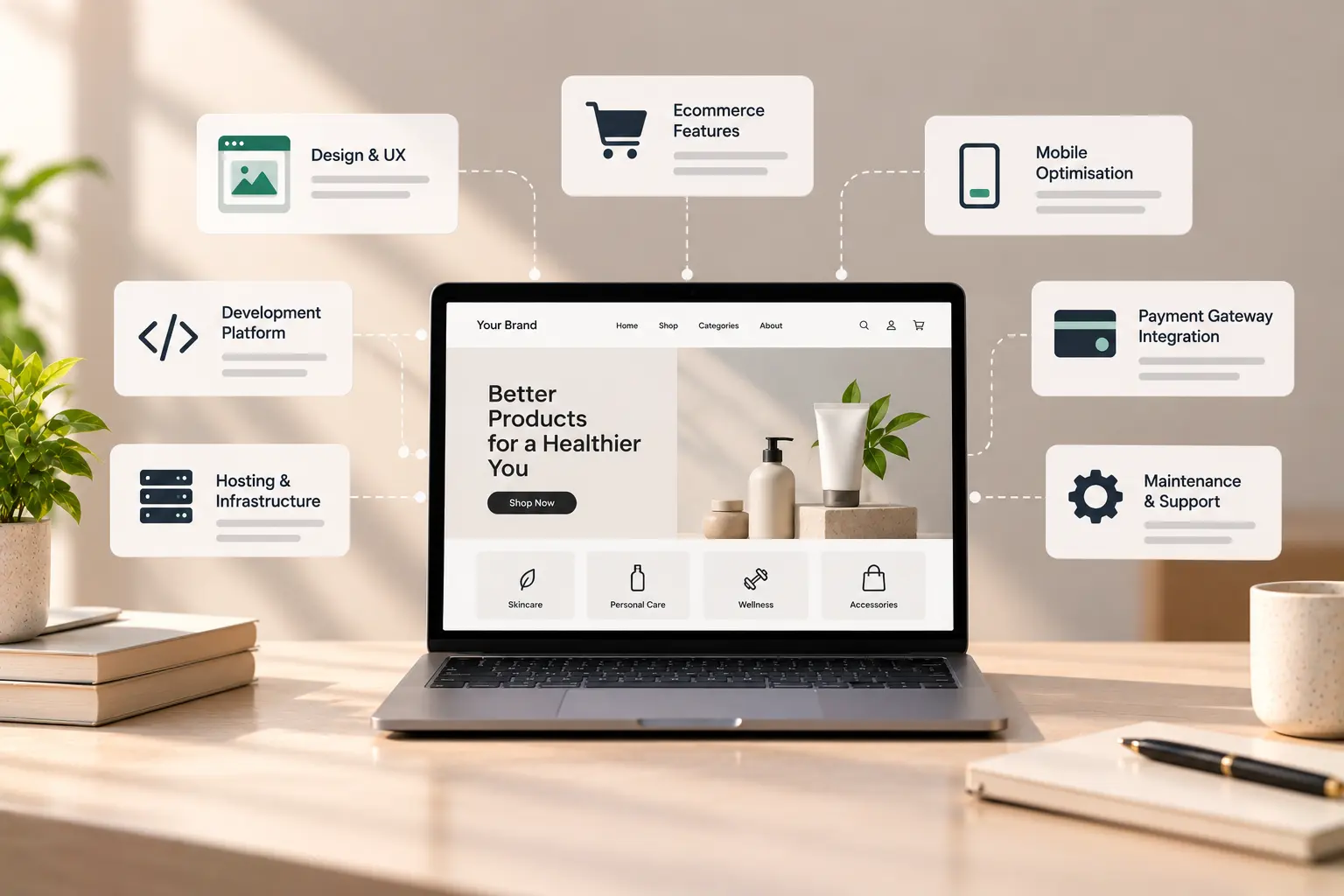
Ecommerce website development in India can cost anywhere from a small one-time setup to a large multi-year investment, and the honest answer to “how much will it cost?” is that it depends on a short list of choices you control. Quotes that look similar on the surface can hide very different scopes, so brands often compare the wrong things. This guide explains what drives the price of an online store in India, the one-time and recurring costs to plan for, how to compare quotes fairly and what to ask a development company before you sign. We do not publish rupee ranges here, because the figures available online come mostly from vendors selling a service, and they vary too widely to be reliable.
Key takeaways (The TL;DR)
- The cost of an ecommerce website depends on platform, design, features, integrations, number of products, migration, security and ongoing support, not on a single standard price.
- Plan for one-time costs (design, development, setup) and recurring costs (hosting, software plans, payment fees, maintenance, marketing), because the second group often exceeds the first over time.
- Payment gateways typically charge a percentage per transaction plus GST, so this cost grows with your sales and should be in your margin plan.
- Compare quotes by scope, deliverables, ownership of code and data, support terms and timelines, and have your lawyer review the contract.
What Drives the Cost of an Ecommerce Website in India?
| Cost driver | What changes the price | Question to ask |
| Platform | Hosted platforms, open-source platforms, enterprise platforms and fully custom builds have different licence, hosting and development needs | What are the licence, hosting and app costs each year? |
| Design | Ready-made theme, customised theme or fully custom design and user experience | How many unique page templates are included? |
| Features | Subscriptions, bundles, loyalty, wishlists, reviews, multi-language, B2B pricing | Which features are in scope and which are extra? |
| Integrations | Payments, shipping, ERP or inventory, CRM, WhatsApp, analytics, marketplaces | Which integrations are included, and who maintains them? |
| Catalogue size | Number of products, variants, categories and data cleaning | Who prepares and uploads product data? |
| Migration | Moving products, customers and orders from an old store, and keeping SEO value | How will URLs, redirects and rankings be protected? |
| Performance and security | Speed work, backups, SSL, access control, monitoring | What security and backup measures are included? |
| Support | Fixed bug-fix period, retainer, or pay-as-you-go | What happens after launch, and what does support cost? |
One-Time vs Recurring Costs
One-time costs
- Planning, wireframes and design.
- Store setup and development, including theme work and custom features.
- Integrations with payment, shipping, inventory and analytics tools.
- Product data entry, photography and content.
- Testing, launch and training.
Recurring costs
- Platform subscription or licence, where applicable.
- Hosting, domain and SSL, depending on the platform.
- Apps, plugins and extensions, some of which are paid and renew annually.
- Payment gateway charges, usually a percentage per transaction plus GST.
- Maintenance, security updates, backups and performance work.
- Marketing, SEO and conversion improvement, which are growth costs, not setup costs.
Many brands only budget for the first list. Over two or three years, recurring costs and marketing often become the larger share, which is why the cheapest build is not always the cheapest store to run.
Which Platform Type Suits Which Business?
| Platform type | Often suits | Watch out for |
| Hosted ecommerce platform | Brands that want to launch quickly with less technical upkeep | Monthly plans, paid apps and transaction terms add up |
| Open-source store on your own hosting | Brands wanting more control and customisation | You are responsible for hosting, security and updates |
| Enterprise ecommerce platform | Larger catalogues, complex rules and integrations | Higher development, hosting and maintenance effort |
| Custom or headless build | Unique experiences and complex requirements | Longest timelines and the highest upkeep, so make sure the need is real |
We have not named specific prices for any platform because plans, apps and fees change often. Ask each vendor for a current written quote and compare the total cost over at least two years.
Features Indian Ecommerce Stores Usually Need
- Payment options: UPI, cards, net banking, wallets and, where it makes sense, cash on delivery with clear rules and charges.
- GST-ready invoicing: correct tax handling on invoices and orders. Confirm requirements with your accountant.
- Shipping and returns: courier integration, pin-code serviceability, tracking and an easy returns flow to manage RTO and cancellations.
- Mobile-first experience: a fast, simple store that works well on mid-range phones and slower networks.
- Product discovery: search, filters, clear category pages and reviews.
- Trust signals: visible contact details, a clear return and refund policy and secure checkout pages.
- WhatsApp and email flows: order updates and abandoned cart messages, with proper consent.
- Analytics and tracking: conversion tracking set up before launch.
If you plan to run Google Shopping, Google Merchant Center sets out requirements such as accurate product data, a working cart and checkout, clear contact details and a visible return and refund policy. Building these in from the start avoids rework later.
How to Compare Quotes from Development Companies
- Scope in writing: pages, features, integrations and number of revisions, so you can compare like with like.
- Timeline and milestones: what is delivered when, and what you need to provide.
- Ownership: you should own your store, content, domain, code you paid for and customer data, subject to third-party licences.
- SEO readiness: clean URLs, redirects, metadata control, speed and structured data should be part of the build, not an afterthought.
- Support after launch: bug-fix period, response times and the cost of changes.
- Contract terms: payment schedule, change requests, exit terms and liability. Have your lawyer review the contract. AKOI is a marketing agency, not a law firm, and this is not legal advice.
Common Budgeting Mistakes
- Choosing the lowest quote without checking what is left out.
- Forgetting recurring costs such as apps, hosting and maintenance.
- Spending the full budget on the build and nothing on marketing, so the store launches to no traffic.
- Adding every feature at launch instead of starting with a focused version and improving from data.
- Skipping migration planning and losing search rankings after relaunch.
- Ignoring customer data and privacy, which are becoming more important under India’s data protection law.
How AKOI Helps
AKOI’s website development team can help plan and build an online store, and our SEO and ecommerce marketing teams make sure the store is ready to be found and to convert from day one. Because we also work with brands on marketplaces and quick commerce platforms such as Blinkit, Zepto, Swiggy Instamart, Amazon Now, Flipkart Minutes and BigBasket, we can help you decide what belongs on your own website and what is better sold on a platform. If you share your products, channels and goals, our team can outline the scope and the cost drivers that matter for your brand.
Frequently Asked Questions
How much does it cost to build an ecommerce website in India?
It depends on the platform, design, features, integrations, catalogue size and support. Ask for a written scope and a quote that separates one-time build costs from recurring costs, and compare total cost over at least two years.
What are the ongoing costs of an ecommerce website?
Typical recurring costs include platform plans or licences, hosting, apps and extensions, payment gateway fees, maintenance and security, and marketing.
Is it cheaper to use a ready-made theme than a custom design?
A ready-made theme usually costs less to start and launches faster, while custom design costs more but can fit your brand and customer journey better. Choose based on how much differentiation matters to your sales.
Do payment gateways charge extra?
Payment gateways typically charge a percentage per transaction plus GST, and the rate depends on the provider, payment method and your agreement. Compare current written terms.
How long does it take to build an ecommerce website?
Timelines depend on scope, from a few weeks for a simple store to several months for complex builds with custom features and integrations. Ask for milestones in the contract.
Do I need SEO and marketing as part of the website project?
Yes. A store needs traffic to earn revenue, and SEO basics are cheaper to build in at the start than to fix later. Plan a marketing budget alongside the build.