


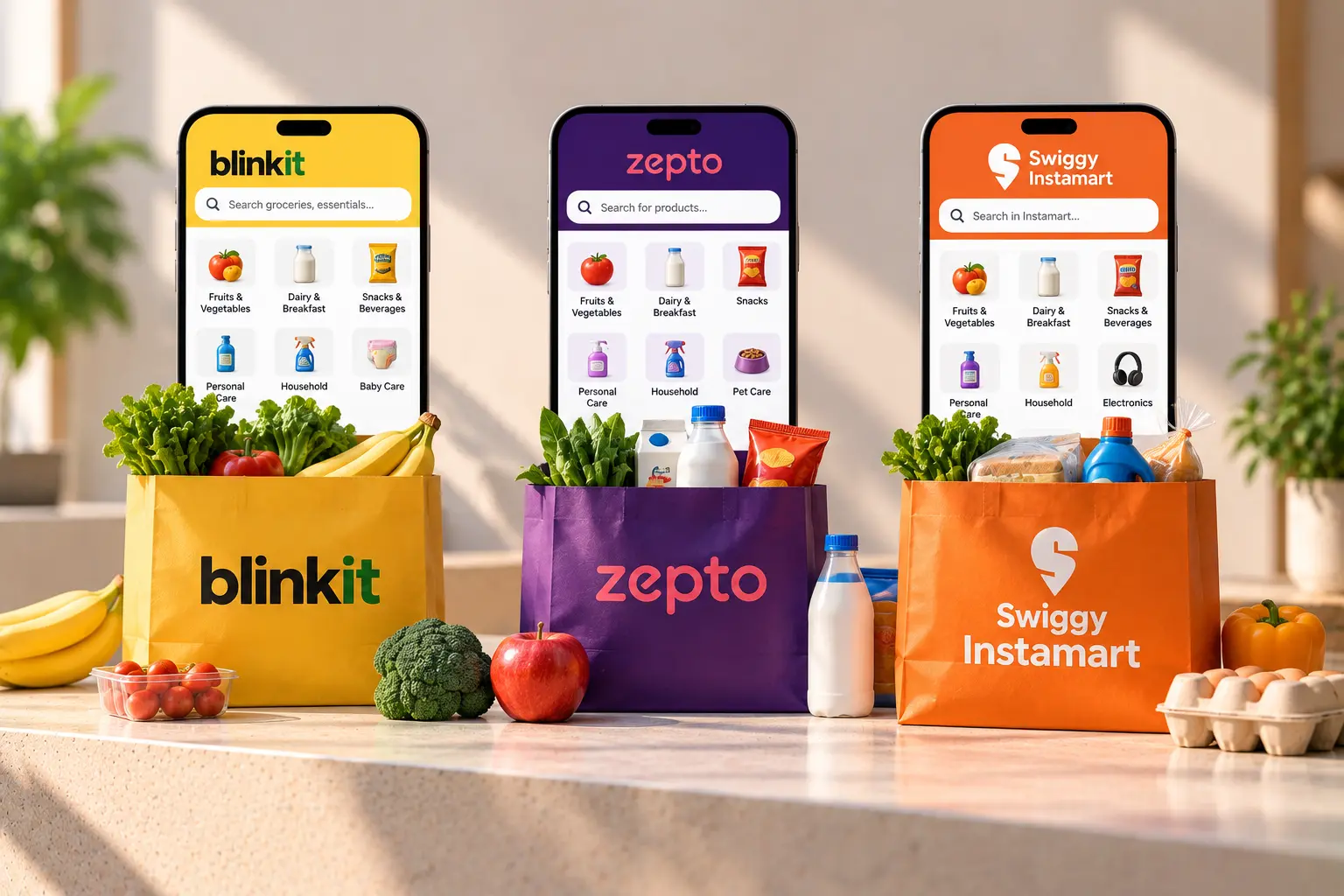
Blinkit vs Zepto vs Swiggy Instamart is the question most new brands ask before launching on quick commerce, and the honest answer is that there is no single best platform for every brand. The right first platform depends on your category, price point, the cities you can supply and how much stock and working capital you can commit. This guide compares the three leading platforms on the factors that matter to a new brand, shares what is publicly known about each, and gives a simple way to decide where to launch first.
Key takeaways (The TL;DR)
- No platform is best for every brand. Choose based on category fit, the cities you can serve, price point, stock readiness and the margin you can afford after platform terms and ads.
- Blinkit reported 31.8 million average monthly transacting customers and 2,443 dark stores in April to June 2026, while Swiggy Instamart reported 1,171 dark stores across 131 cities, so both are large, and Zepto is another major platform with its own city strengths.
- Platform scale is less important than availability: a product that is out of stock at the nearest dark store cannot sell, whichever platform you choose.
- Start with one or two platforms and a few cities where you can keep stock, then expand once listings, availability and ad results are stable.
Blinkit vs Zepto vs Swiggy Instamart at a Glance
| Factor | Blinkit | Zepto | Swiggy Instamart |
| Scale (latest public figures) | 31.8M average monthly transacting customers and 2,443 dark stores in Apr to Jun 2026 | No company figure verified for this post; an independent July 2026 store map counted about 1,088 stores, as a lower bound | 1,171 dark stores in 131 cities and gross order value of Rs 7,907 crore in Apr to Jun 2026 |
| Footprint in the July 2026 independent store map | Largest store count nationally, with the widest spread including smaller cities | Leads in Hyderabad in that map, and is close to Blinkit in Bengaluru | Third by store count in that map, and closest to the others in Bengaluru |
| Verify before you launch | Category fit, city and pin-code coverage, and terms agreed at onboarding | Category fit, city and pin-code coverage, and terms agreed at onboarding | Category fit, city and pin-code coverage, and terms agreed at onboarding |
Scale figures come from company results and an independent store map, and different methods give different counts. The Blinkit and Instamart figures are as reported from Eternal’s Q1 FY27 results and Swiggy’s results for April to June 2026, while an independent July 2026 map of publicly visible stores counted fewer stores for each platform and calls its numbers a lower bound. Market share estimates also vary by source. One estimate for early 2026 put Blinkit at about 46 percent, Swiggy Instamart at about 24 percent and Zepto at about 22 percent. Treat all of these as indicators, not exact measures.
What Actually Decides Where a New Brand Should Launch?
1. Category and price fit
Each platform’s shopper mix and assortment differ. A premium or gourmet product may behave very differently from an everyday staple, so ask which platform already sells brands like yours, and what their price positioning looks like on the app.
2. Cities and pin codes you can serve
Quick commerce works at dark-store level, so a platform is only useful where you can keep stock close to its stores. Map your supply chain first, then pick the platform with strong coverage in those cities. In Bengaluru the leading platforms have comparable store counts in the independent map, while in other cities one platform may lead, so the answer changes by city.
3. Stock, supply and working capital
Quick commerce rewards brands that can stay in stock. Out-of-stock products lose rankings and ad efficiency. Be realistic about how many cities and SKUs you can keep supplied, and plan for the payment cycle and returns or wastage terms in your agreement.
4. Margin after platform terms and ads
Neither platform publishes a standard rate card for brands, so commercial terms are agreed during onboarding and can differ by category. Work out your margin after trade terms, logistics, wastage and advertising before you commit to a city plan, and have a lawyer review any supply agreement.
5. Advertising and visibility
Search, category and banner placements on the platforms decide who gets seen. Ads work only when listings and availability are in place, so build the base first, then scale spend.
A Simple Launch Plan for a New Brand
- Pick 10 to 20 hero SKUs: products with clear value, good images and strong repeat potential.
- Choose a first platform: use the factors above, and ask for category and city guidance during onboarding.
- Start in two to three cities: where your stock can reliably reach multiple dark stores.
- Fix listings before ads: titles, images, pack sizes, pricing and descriptions.
- Track availability daily: by city and pin code, and fix gaps quickly.
- Test ads in stages: track total sales against ad spend, not only ad-attributed sales.
- Review at 30 and 60 days: expand to a second platform or more cities only when availability and ad efficiency are stable.
Other quick commerce options include Amazon Now, Flipkart Minutes and BigBasket, which may suit some brands and categories. Many brands eventually sell on several platforms, and the first choice is simply where to start learning.
What AKOI’s Published Results Show
AKOI publishes results from brands across platforms. A gourmet brand on Blinkit grew revenue from Rs 2.2 lakh to Rs 11.4 lakh in one quarter while its total ad cost of sales fell from 59 percent to 22.5 percent. An edible oil and ghee brand on Swiggy Instamart grew from Rs 6.4 lakh to Rs 22.5 lakh while ad cost of sales fell from 36 percent to 8.5 percent. A brand on Zepto grew GMV from Rs 11 lakh to Rs 43 lakh with ad cost of sales falling from 63 percent to 32 percent. These come from different brands, categories and time periods, so they should not be used to rank the platforms against each other. They show what is possible when listings, availability and ads are managed together. See more on our portfolio page.
How AKOI Helps Brands Launch on Quick Commerce
AKOI’s quick commerce marketing team helps brands choose where to start, prepare catalogues, manage advertising, track availability at pin-code level, and plan pricing and trade terms, across Blinkit, Zepto, Swiggy Instamart, Amazon Now, Flipkart Minutes and BigBasket. If you share your category, price points and target cities, our team can suggest a first platform and a launch plan.
Frequently Asked Questions
Which is better for a new brand, Blinkit, Zepto or Swiggy Instamart?
None is best for every brand. Compare category fit, cities you can supply, stock readiness and margin after platform terms and ads. Many brands start with one or two platforms and expand once results are stable.
Is Blinkit the biggest quick commerce platform?
Public reports and estimates place Blinkit as the largest of the three by scale, but figures vary by source and period. Size matters less than availability and fit for your category and cities.
Can a small brand launch on quick commerce?
Yes, if it can maintain stock at dark stores and meet platform onboarding requirements. Start with a focused set of products and a few cities.
Do I need ads to sell on quick commerce platforms?
Ads help visibility, especially in competitive categories, but they only work when listings, pricing and availability are in place. Build those first.
How long does it take to see results?
It depends on onboarding time, stock availability, category competition and ad spend. Review performance in stages, such as at 30 and 60 days, rather than expecting fixed timelines.
Should I sell on multiple quick commerce platforms?
Many brands do over time. Starting with one or two lets you fix listings and supply before spreading across more platforms and cities.