


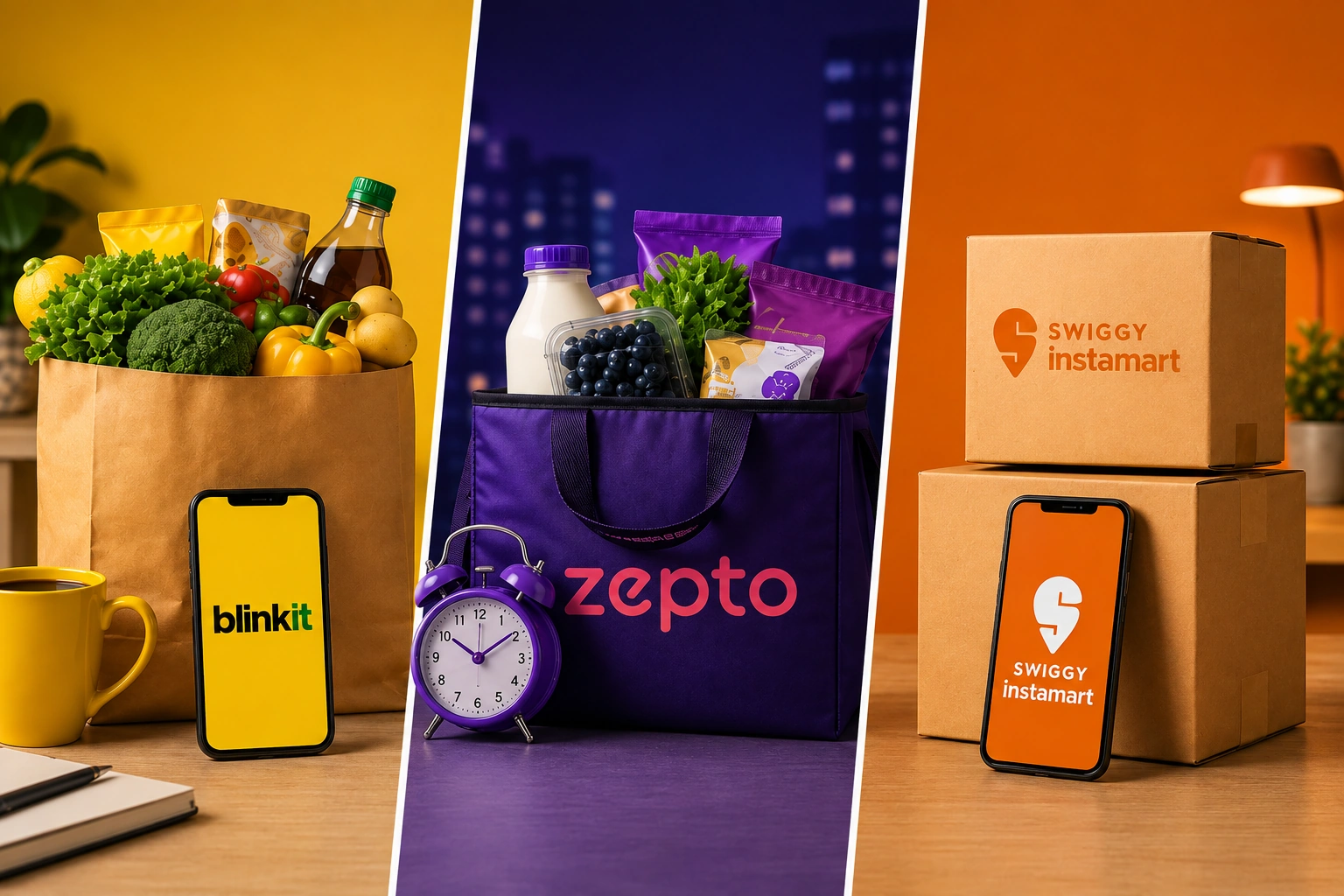
Blinkit vs Zepto vs Swiggy Instamart is one of the most important comparisons for brands deciding where to invest their first quick commerce budget. Each platform has a different dark store footprint, customer base, geographic reach, and path to visibility. Choosing the right platform depends on your category, target audience, and growth objectives.
Key takeaways (The TL;DR)
- Blinkit leads on scale with 2,243 dark stores and roughly 30 lakh daily orders, well ahead of Zepto’s 1,139 stores and Instamart’s 12.5 lakh daily orders.
- BigBasket, despite being one of the earliest movers, trails the pack at 5-6 lakh daily orders and is actively consolidating from 76 to 40 cities to focus on profitability over reach.
- Amazon Now and Flipkart Minutes are scaling fast, with Flipkart Minutes adding roughly 100 dark stores a month and Amazon Now targeting 300 cities.
- No single platform wins for every brand. The right choice depends on your category, target audience, and whether reach or a specific customer overlap matters more.
Blinkit
Blinkit is the clear market leader, operating 2,243 dark stores and clocking roughly 30 lakh average daily orders as of mid-2026, well ahead of every other platform. That scale gives it the deepest reach into Tier 2 and Tier 3 markets of any quick commerce platform, and the largest, most established customer base to advertise into.
Best for: Brands prioritising the widest possible geographic reach and the largest existing customer base.
Zepto
Zepto operates 1,139 dark stores with roughly 24-25 lakh average daily orders, concentrated more heavily in metro and large urban markets. Its customer base skews younger and more urban than Blinkit’s, which can make it a stronger fit for brands whose core audience is metro-based Gen Z and millennial shoppers.
Best for: Brands targeting a younger, metro-first audience over broad geographic coverage.
Swiggy Instamart
Swiggy Instamart runs roughly 12.5 lakh average daily orders across its dark store network in around 129 cities, with the added advantage of cross-selling into Swiggy’s existing food delivery user base. That overlap can give certain categories, particularly food and beverage, a discovery advantage that’s harder to replicate on a standalone grocery app.
Best for: Food, beverage, and snacking brands that benefit from Swiggy’s existing food delivery audience overlap.
BigBasket
BigBasket was one of the earliest movers into quick commerce but now trails the market leaders, running around 664-850 dark stores with 5-6 lakh average daily orders, a fraction of Blinkit’s volume. The Tata Digital-owned platform is actively consolidating its footprint from 76 cities to roughly 40, prioritising profitability in denser, higher-performing markets over broad geographic spread.
Best for: Brands wanting exposure to BigBasket’s more grocery-focused, value-conscious customer base in the metro and Tier 1 cities it’s consolidating around.
The New Entrants: Amazon Now and Flipkart Minutes
Both Amazon and Flipkart have moved aggressively into quick commerce. Flipkart Minutes has scaled to around 880 dark stores, adding roughly 100 new stores a month, while Amazon Now runs approximately 500 stores with plans to expand to 300 cities. Neither has caught up to Blinkit’s scale yet, but both bring something the pure-play quick commerce apps don’t: an existing marketplace customer base and Prime or Flipkart Plus loyalty overlap, which could reshape category dynamics as their dark store networks mature.
Quick Comparison
| Platform | Dark Store Scale | Strongest For |
|---|---|---|
| Blinkit | 2,243 stores, ~30 lakh daily orders | Widest reach, largest existing user base |
| Zepto | 1,139 stores, ~24-25 lakh daily orders | Younger, urban-first audience |
| Swiggy Instamart | ~12.5 lakh daily orders, 129 cities | Food and beverage, Swiggy audience overlap |
| BigBasket | 664-850 stores, ~5-6 lakh daily orders | Value-conscious grocery shoppers in Tier 1 cities |
| Flipkart Minutes | ~880 stores, adding ~100/month | Flipkart marketplace and loyalty overlap |
| Amazon Now | ~500 stores, targeting 300 cities | Amazon Prime and marketplace overlap |
Blinkit vs Zepto vs Swiggy Instamart: Which Has Better Advertising Opportunities?
Beyond raw reach, each platform’s advertising auction behaves differently. Blinkit’s scale means more advertisers competing for the same visibility slots, which can push category ad costs higher during peak demand windows, particularly in metro cities where competition is fiercest. Zepto’s smaller, more concentrated network often gives newer brands a slightly easier path to visibility, since fewer established players are bidding as aggressively across its category ads.
Swiggy Instamart’s advertising economics benefit from cross-platform data. A brand that already runs Swiggy food delivery ads can sometimes carry audience insights across to Instamart campaigns, giving an efficiency edge that a standalone quick commerce app can’t offer. For the newer entrants, Amazon Now and Flipkart Minutes, advertising inventory and category ad formats are still maturing, which means costs are currently lower but the tools for granular targeting and reporting are less developed than on the established three platforms.
So Which Platform Should You Start With?
If reach matters most, Blinkit’s scale makes it the default first platform for most brands. If your audience skews young and metro-based, Zepto often delivers stronger engagement per rupee spent. Food and beverage brands frequently see the fastest early traction on Swiggy Instamart because of the built-in audience overlap. BigBasket suits brands wanting exposure to a more value-conscious grocery audience in the Tier 1 cities it’s now consolidating around, though its lower order volume means it usually isn’t a brand’s primary platform. And for brands already selling well on Amazon or Flipkart’s core marketplace, testing Amazon Now or Flipkart Minutes can capture that same loyal customer base without starting from zero.
In practice, most brands beyond an initial test end up running two or more platforms simultaneously, since each captures a genuinely different customer, not just a different slice of the same one. Independent trackers like QuickCommerceMap publish city-by-city dark store data that’s worth checking before committing budget to a platform your target cities might not even be covered by yet.
Conclusion
There’s no single best quick commerce platform, only the best platform for a specific audience and category. The smartest approach is choosing based on where your actual customer already shops, not which platform is loudest in the market this quarter. A properly managed quick commerce marketing strategy treats all five platforms as one connected system rather than five separate bets.
Frequently Asked Questions
Which quick commerce platform has the widest reach in India?
Blinkit, with 2,243 dark stores and roughly 30 lakh average daily orders as of mid-2026, the largest network of any quick commerce platform in India.
Is it better to launch on one quick commerce platform or several at once?
Most brands start with one platform to prove the model, then expand once they understand their category’s performance, since each platform reaches a meaningfully different customer segment.
Are Amazon Now and Flipkart Minutes worth testing yet?
For brands already established on Amazon or Flipkart’s core marketplace, yes, the loyalty and customer overlap can provide a faster path to initial traction than starting cold on a pure-play quick commerce app.
Why is BigBasket falling behind Blinkit, Zepto, and Instamart?
BigBasket entered quick commerce later in its full-fledged form and is now prioritising profitability over geographic spread, consolidating from 76 cities to around 40. Its 5-6 lakh average daily orders trail well behind the market leaders, though it remains a relevant option in the denser cities it’s focusing on.
How often does quick commerce dark store coverage change?
Frequently. Dark store networks are expanding and consolidating on a monthly basis across most platforms, so it’s worth checking current city-level coverage before committing budget rather than relying on figures that may be several months old.