


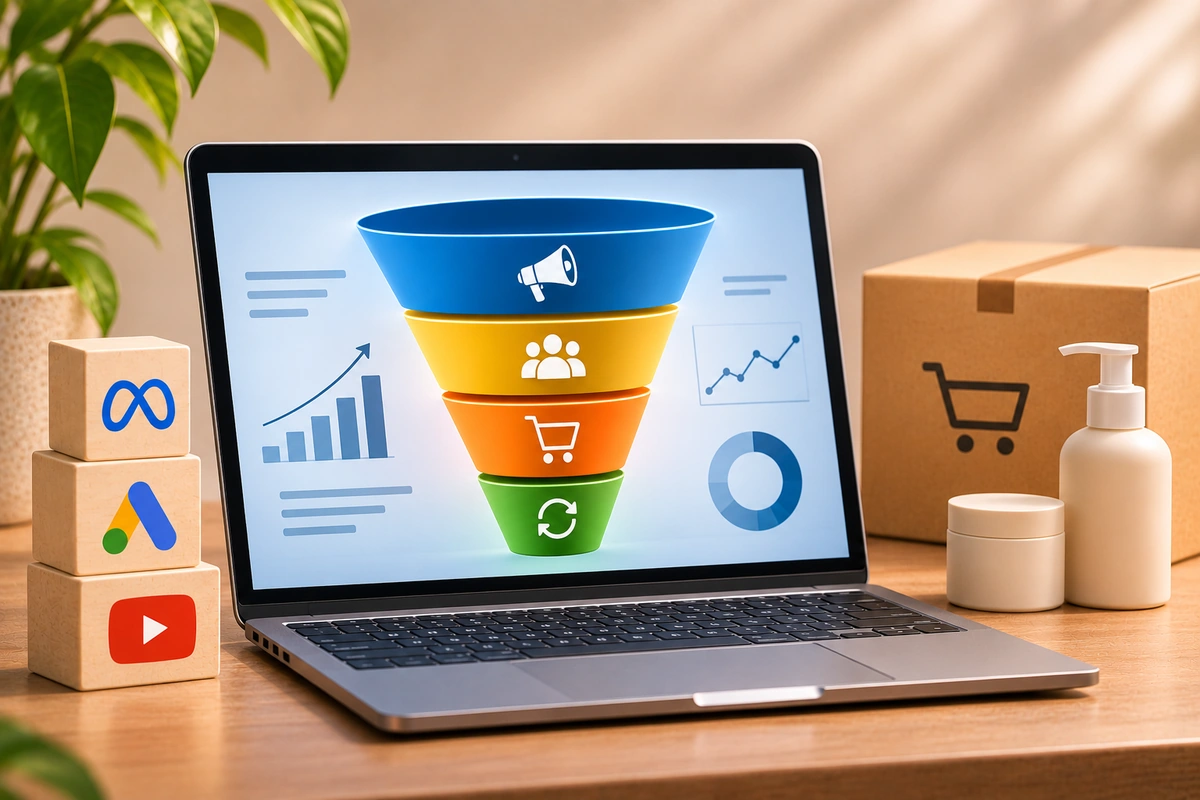
Performance marketing for D2C brands works when every rupee of ad spend is tied to a margin target, a measurable action and a stage of the customer journey, not just to a ROAS number on a dashboard. This guide shows how a D2C brand can build a full-funnel performance programme: set the maths first, split spend across funnel stages, measure honestly, test creative and retain the customers you paid to acquire.
Key takeaways (The TL;DR)
- Start with unit economics: your break-even ROAS is one divided by your contribution margin before ads, so a 40 percent margin means a break-even ROAS of 2.5.
- Plan spend across the funnel (reach, consideration, conversion, retention) instead of pouring everything into bottom-funnel retargeting, which mostly harvests demand that already exists.
- Platform-reported ROAS is not proof of incremental sales. Use Meta’s Conversions API alongside the Pixel and, where available, controlled lift tests.
- Judge any partner on margin-aware targets, access through your own accounts and honest measurement, never on a promised ROAS.
Start With Unit Economics, Not Platforms
Before choosing channels, work out what an order can afford to spend on advertising. Take the selling price, subtract product cost, shipping, packaging, payment fees, returns and discounts, and what remains is your contribution margin before ads. Break-even ROAS is one divided by that margin as a fraction. At a 40 percent margin it is 2.5, at 25 percent it is 4. Any ROAS target above break-even leaves room to cover fixed costs and profit, and one below it loses money on every order, however good the dashboard looks. This is simple arithmetic, so replace the example with your own numbers.
- CAC (customer acquisition cost): ad and related spend divided by new customers, not total orders.
- First-order margin vs lifetime margin: categories with repeat purchase can accept a lower first-order return, if repeat data supports it.
- Blended view: track total revenue against total marketing spend across all channels, so platform double-counting cannot hide a problem.
- Return and cancellation rates: include cash-on-delivery losses, because gross ROAS ignores them.
Performance Marketing for D2C Brands: The Full-Funnel Model
| Funnel stage | Goal | Typical formats | Main metric |
| Reach | Bring in new audiences who do not know you | Short video and creator-style creative on social, YouTube | Cost per thousand reached, thumb-stop and hold rates |
| Consideration | Build intent and trust | Product demos, reviews, comparison content, Search for category terms | Engaged visits, add-to-cart rate |
| Conversion | Turn intent into orders | Search and Shopping ads, catalogue ads, marketplace and quick commerce ads | CAC, ROAS against break-even, conversion rate |
| Retention | Win repeat orders | WhatsApp and email flows, loyalty, replenishment reminders | Repeat rate, revenue per customer |
Many D2C accounts overfund the conversion row because it reports the best numbers. Retargeting and branded search often capture people who were already coming, so a rising ROAS there can hide a shrinking pipeline of new customers. A healthier plan funds each stage and reviews the blended result.
Where D2C Brands Spend: Channel Roles
- Meta (Facebook and Instagram): strongest for discovery and creative testing, and catalogue ads for retargeting. Quality of creative is the main lever.
- Google (Search, Shopping, Performance Max, YouTube): captures high-intent demand and extends reach on video. Keep branded and non-branded terms separate.
- Marketplaces and quick commerce: sponsored ads on Amazon, Flipkart, Blinkit, Zepto, Swiggy Instamart, Amazon Now, Flipkart Minutes and BigBasket reach shoppers already in buying mode, and need listings, price and stock to be in order first.
- CRM channels: WhatsApp, email and SMS turn first orders into repeat orders at a lower cost than new acquisition.
- Creators and influencers: useful for trust and creative supply, with disclosure rules to follow.
Measuring Honestly: Attribution and Incrementality
Every platform credits itself for conversions, so the sum of platform-reported sales often exceeds real sales. Three habits keep measurement honest.
1. Fix tracking at the source
Meta recommends using the Conversions API in addition to the Pixel and sharing the same events through both, because server events can capture conversions the browser misses. Per Meta’s Conversions API best practices, both events should use the identical event name and carry an event ID so Meta can deduplicate them, and only events matched to a Meta account can be used for attribution and delivery optimisation.
2. Understand what attribution models do
Google describes data-driven attribution as giving credit for conversions based on how people engage with your ads, using conversion paths, and recommends at least 200 conversions and 2,000 ad interactions in 30 days for best results. Low-volume accounts can still use it, but credit may be less precise. Attribution distributes credit among ads that were seen. It does not prove the sale would not have happened without them.
3. Test incrementality where you can
Google describes Conversion Lift as a controlled experiment that compares a group that sees ads with a control group that does not, to measure conversions caused by the ads. It is not available for all accounts, and you may need to contact your Google account representative. If formal tools are not available to you, simpler tests such as a regional holdout or a planned pause on one channel, read against blended revenue, give directional evidence.
Creative Testing That Compounds
- Test one variable at a time: hook, offer, format or proof, so you know what moved the result.
- Keep a swipe file of winners and losers with the reason, and brief each new batch from it.
- Refresh creative before fatigue shows up as rising CAC, not after.
- Match the landing page to the ad, because a mismatch wastes the click.
The Site Matters as Much as the Ad
Performance spend multiplies whatever the website does. Check mobile load speed, clear pricing and delivery information, reviews, easy checkout and payment options including prepaid incentives. A one-point lift in conversion rate improves the return on every channel at once, so audit the funnel before you raise budgets.
What to Ask a Performance Marketing Agency
| Question | What a good answer sounds like |
| How do you set targets? | From your contribution margin and CAC payback, not a generic ROAS number |
| Whose accounts run the ads? | Yours, with you as owner and the agency added with permissions |
| How do you measure beyond platform reports? | Blended revenue, server-side tracking and incrementality tests where possible |
| How is creative handled? | A testing plan with named hypotheses, not random variations |
| What do you report weekly? | Spend, CAC, ROAS against break-even, conversion rate, repeat rate and learnings |
| Will you guarantee ROAS? | No. Results depend on product, price, creative and market, so honest partners avoid guarantees |
Common Mistakes
- Setting ROAS targets without knowing break-even.
- Judging performance on platform-reported numbers alone.
- Scaling budget before creative and the site are ready.
- Ignoring returns and cash-on-delivery losses.
- Neglecting retention and paying to acquire the same customer repeatedly.
How AKOI Can Help
AKOI works with D2C, FMCG and ecommerce brands across India. Our performance marketing and PPC team runs paid media on Google, Meta and marketplaces, our social media marketing work covers creative and community, and our ecommerce marketing team connects marketplace and quick commerce ads to listings, pricing and stock. See examples in our portfolio, or talk to us about a margin-first performance plan.
Note: platform features and policies change, and results depend on product, category, budget and execution. Check current documentation before you plan.
Frequently Asked Questions
What is performance marketing for D2C brands?
It is paid and owned marketing where spend is tied to measurable actions such as orders, with targets set from your margins, across the funnel from first awareness to repeat purchase.
How do I calculate break-even ROAS?
Divide one by your contribution margin before ads, as a fraction. A 40 percent margin gives 2.5 and a 25 percent margin gives 4. Use your own cost data.
Is platform-reported ROAS reliable?
It is useful for optimisation but not proof of incremental sales, because platforms credit themselves. Combine it with blended revenue and, where possible, lift tests.
What is incrementality testing?
It compares a group exposed to ads with a control group that is not, to estimate conversions the ads caused. Google offers Conversion Lift to eligible accounts.
Should I use the Meta Pixel and Conversions API together?
Meta recommends using the Conversions API in addition to the Pixel, sending the same events and deduplicating them with matching event names and event IDs.
How much should a D2C brand spend on retargeting?
There is no fixed share. Retargeting often captures existing demand, so fund prospecting and retention as well and judge the blended result.
Can AKOI run performance marketing for my D2C brand?
AKOI runs paid media and marketplace advertising for brands across India. Contact us to discuss your products and margins.