


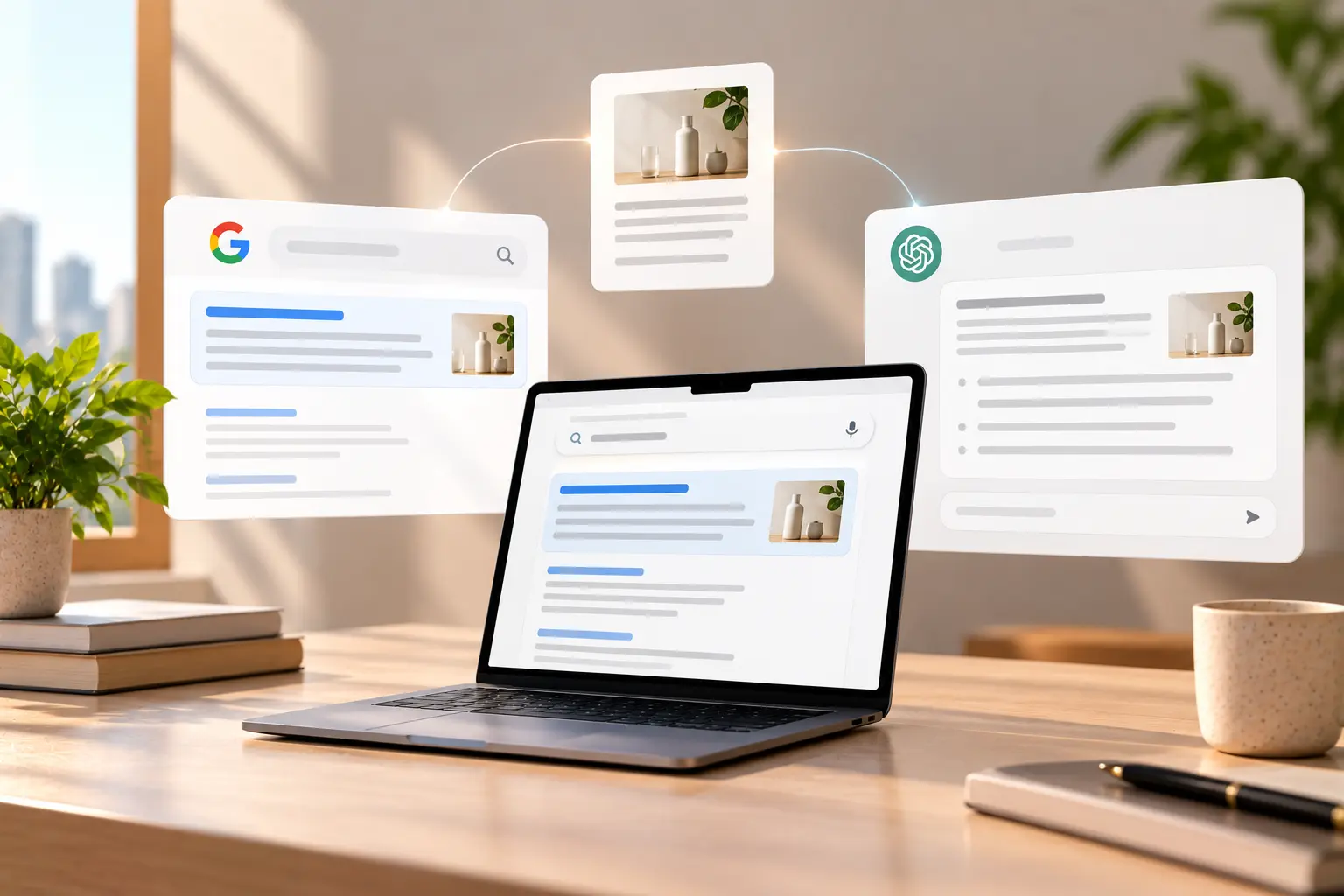
GEO and AEO, short for generative engine optimization and answer engine optimization, are the practice of making your content easy for AI tools such as Google’s AI Overviews and AI Mode, ChatGPT and Gemini to find, understand and cite when people ask questions. More buyers now ask an AI tool for a shortlist before they ever visit a website, so being named in that answer is becoming part of how brands get discovered. This guide explains what GEO and AEO mean, what Google itself says you need to do, and a practical plan for Indian brands, without hype or guaranteed outcomes.
Key takeaways (The TL;DR)
- AEO focuses on giving clear, direct answers to the questions your buyers ask, and GEO focuses on being cited in AI-generated responses. Both rest on strong SEO fundamentals.
- Google says there are no additional requirements or special markup to appear in AI Overviews or AI Mode: a page must be indexed and eligible to show with a snippet in Search.
- What helps in practice: answer-first writing, original facts and data, clear structure, named authors and sources, consistent brand details across the web, and a technically healthy site.
- No one can guarantee AI citations. Treat any agency that promises them with caution, and measure progress through search data, referral traffic and enquiries.
What Are GEO and AEO?
Answer engine optimization (AEO) means structuring content so that a search feature or assistant can lift a clear answer from it. Think of a page that states the answer to “how much does X cost” or “how do I choose Y” in the first lines, then explains it. Generative engine optimization (GEO) is a broader idea: making your brand and content likely to be used and cited when AI systems write a response from many sources.
The terms are new, but the foundation is familiar. Helpful, trustworthy, well-organised content on a technically sound site has always been what search engines try to reward. GEO and AEO add a sharper focus on direct answers, original information and how your brand appears across the wider web.
What Does Google Say You Need to Do?
According to Google’s guidance on AI features and your website, a page can appear as a supporting link in AI Overviews or AI Mode if it is indexed and can be shown in Google Search with a snippet. Google states that there are no additional technical requirements, and that you do not need special files, markup or schema to appear. Meeting the requirements does not guarantee that a page will be crawled, indexed or shown.
Google’s recommended basics include allowing crawling, using internal links, giving a good page experience, keeping important content in text, making sure structured data matches the visible page and keeping Business Profile and Merchant Center information current. It also notes that these features may run several related searches across subtopics to build a response, which can surface a wider set of links than a classic search. Traffic from these features is counted in the Web search type of Search Console’s Performance report.
This is an important reality check. Much of what is sold as a secret AI trick is, according to Google, not required. The sensible approach is to do strong SEO first, then improve how clearly and credibly your content answers real questions.
SEO vs AEO vs GEO at a Glance
| Approach | Main goal | Typical focus |
| SEO | Rank pages in search results | Technical health, content, links, page experience |
| AEO | Be the clear, direct answer to a question | Answer-first writing, question headings, FAQs, concise definitions |
| GEO | Be cited in AI-generated responses | Original data, credible sources, brand mentions, consistent entity details |
A Practical GEO and AEO Plan for Indian Brands
1. Start with the questions buyers ask
List the questions prospects ask before they buy: costs, comparisons, how to choose, what to avoid. Use sales calls, support tickets, reviews and search suggestions. Build pages that answer each one clearly, starting with the answer.
2. Write answer-first, then add depth
Open each section with a short, direct answer of one or two sentences, followed by context, examples and caveats. Use descriptive headings and short paragraphs. Keep important facts in plain text, not only in images or scripts.
3. Add original information
AI systems and readers both value content that adds something: your own data, case studies, benchmarks, pricing logic or first-hand experience. When you use numbers, say where they come from and when they were true, and link to the primary source.
4. Show who is behind the content
Name authors, show credentials and keep an About page and contact details clear. For topics that affect money, health or legal decisions, take extra care with accuracy and ask a qualified professional to review.
5. Keep your brand details consistent
Use the same business name, description, address and service names across your website, Google Business Profile, social profiles and directories. Consistency helps systems understand who you are and what you do.
6. Earn mentions beyond your own site
Reviews, industry coverage, partnerships, podcasts and credible directories all shape how your brand is described across the web. Focus on being genuinely useful and visible in the places your buyers read.
7. Fix the technical basics
Make sure important pages can be crawled and indexed, load quickly, work on mobile and are linked internally. If you add structured data, make sure it matches what visitors can see on the page. Note that Google stopped showing FAQ rich results in Search, so add FAQs for readers and for clarity, not for a dropdown.
8. Refresh and measure
Update key pages when facts change. Track impressions and clicks in Search Console, referral traffic from AI tools in your analytics, branded search growth and the enquiries that mention AI or Google answers. Because AI answers vary by user, query and time, test prompts on a regular schedule and keep a log, but treat any single result as a sample, not a ranking.
What to Be Careful About
- Guaranteed citations: no one controls what an AI system will say, so promises of guaranteed placement are a red flag.
- Fake or paid reviews and mass-produced pages: they risk your reputation and can violate platform policies.
- Unsourced claims: AI answers can repeat errors, so accuracy protects your brand.
- Over-reliance on one platform: AI features, products and referral behaviour change often, so keep a balanced mix of SEO, content, social and direct channels.
- Contracts: before signing with any agency, have your lawyer review the terms. AKOI is a marketing agency, not a law firm, and this is not legal advice.
Where AKOI Fits
AKOI helps brands plan SEO and AI search visibility alongside content, social and marketplace marketing. For D2C, FMCG and ecommerce brands, that includes answering the questions buyers ask on Google and AI tools, and making sure product information is consistent where shoppers actually buy, including Blinkit, Zepto, Swiggy Instamart, Amazon Now, Flipkart Minutes and BigBasket. If you would like a review of how your brand shows up for key buyer questions today, our team can suggest the first fixes.
Frequently Asked Questions
What is the difference between GEO and AEO?
AEO focuses on giving clear, direct answers that search features and assistants can use. GEO is broader and focuses on being cited and described accurately in AI-generated responses. In practice the work overlaps heavily.
Do I need special schema or an llms.txt file to appear in AI Overviews?
Google states that no additional files, markup or special structured data are needed to appear in AI Overviews or AI Mode. Standard SEO requirements apply. Other AI tools may behave differently, so test rather than assume.
Is GEO replacing SEO?
No. Google says normal Search eligibility is what counts for its AI features, so SEO remains the foundation. GEO and AEO are extra layers of clarity, credibility and brand presence on top of it.
How can I tell if AI tools mention my brand?
Ask your key buyer questions in the tools your customers use, record the answers on a schedule and note whether your brand is named and described correctly. Also watch Search Console, referral traffic and enquiry sources.
How long does it take to be cited by AI tools?
There is no fixed timeline. Pages must be crawled and trusted, and AI answers vary by query and over time, so treat it as ongoing work.
Can a small business do GEO and AEO?
Yes. Start with your best customer questions, answer them clearly on your website, keep your profiles consistent and collect genuine reviews.