


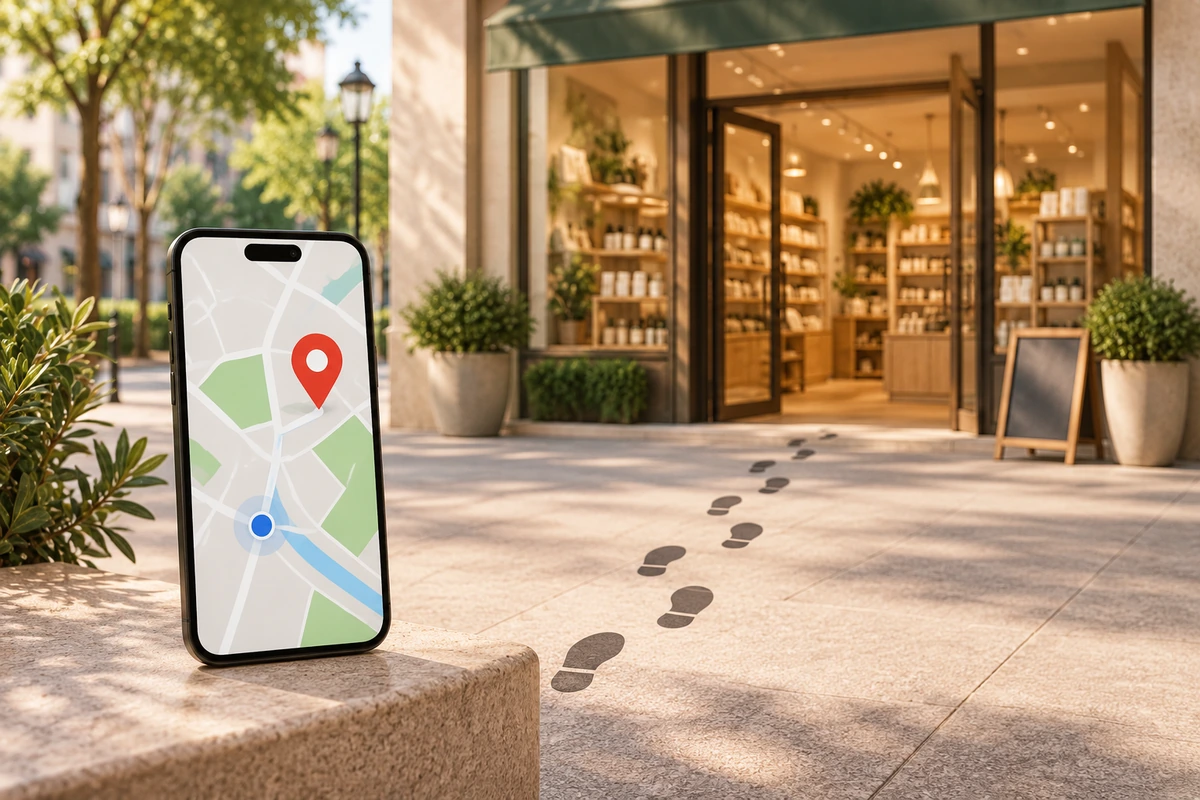
A well-built Google Business Profile drives local store footfall more reliably than almost any other single marketing asset a local business owns, and the numbers back that up directly: 46 percent of all Google searches carry local intent, and 76 percent of people who perform a local search visit a physical location within 24 hours. Google Business Profile signals now account for roughly a third of what determines whether a business shows up in the Local Pack, the map and three-listing block that appears above organic results for local searches, which makes this one profile a bigger lever on walk-in traffic than most businesses realize.
Key takeaways (The TL;DR)
- 76 percent of people who perform a local Google search visit a physical location within 24 hours, and Google Business Profile signals account for roughly a third of Local Pack ranking, making the profile a direct lever on footfall.
- Selecting the correct primary category is the single strongest ranking factor a business controls, according to Whitespark’s 2026 Local Search Ranking Factors survey, ahead of reviews, photos, or posting frequency.
- A complete profile earns up to 7 times more clicks than an incomplete one, and businesses that respond to all their reviews see up to 18 percent more revenue and convert inquiries at roughly 50 percent higher rates.
- Posts, photos, and offers function as conversion and trust tools rather than direct ranking signals, so they matter for turning a click into a visit, even though they don’t move Local Pack position on their own.
Why This Profile Matters More Than Most Businesses Realize
Local search intent is enormous, and it converts to real-world visits at a rate almost no other digital channel matches. Nearly half of all Google searches carry local intent, and three-quarters of people who search locally act on it within a day by physically showing up. Local SEO built around a strong Google Business Profile also tends to produce a meaningfully lower cost per lead than traditional outbound marketing for small and mid-sized businesses, which makes this one of the more efficient acquisition channels available, not just a nice-to-have listing to set up once and forget.
Primary Category Is the Single Biggest Lever You Control
Of everything a business can directly control about its Google Business Profile, choosing the correct primary category has the single largest impact on Local Pack ranking, ahead of reviews, photos, or how often the profile gets updated. Google uses this category to decide which searches a business is even eligible to appear for in the first place, so choosing something too broad, like “Store” when a more specific option like “Pet Store” exists, forces unnecessary competition against every kind of retailer nearby and dilutes relevance for the searches that actually matter. Secondary categories add further visibility, but only when they accurately describe genuine parts of the business rather than being added to cast a wider net.
Reviews: Volume, Recency, and Response Rate All Matter
Reviews are the second most influential ranking factor after category selection, and they work on two separate axes: they directly affect ranking, and they directly affect whether a shopper who finds the listing actually visits. A steady flow of reviews over 90 days ranks better than a sudden burst of fifty followed by silence, since Google reads consistent review velocity as a sign of an active, trustworthy business. Responding to reviews, positive and negative alike, correlates with up to 18 percent more revenue and roughly 50 percent better conversion on inquiries, which makes review response one of the highest-leverage, lowest-cost habits a local business can build into its routine.
Keep NAP Consistent Everywhere
Name, address, and phone number, commonly shortened to NAP, need to match exactly across the Google Business Profile, the business website, and every directory listing the business appears on. Even a minor discrepancy, an abbreviated street suffix on one listing, a different phone number format on another, can fragment how Google understands the business as a single entity, and that fragmentation suppresses Local Pack visibility. This is a genuinely easy fix compared to most local SEO work, and it’s also one of the most commonly overlooked, since discrepancies often accumulate slowly across old directory listings a business forgot it was even on.
Posts, Photos, and Business Hours: Conversion Tools, Not Ranking Hacks
Posts, photos, offers, and keeping business hours accurate all matter, but mostly for conversion rather than ranking directly. Publishing Posts regularly lifts click-through and engagement within the local panel, and businesses that are open at the exact moment someone searches rank higher than the same business appearing closed, but neither of these moves Local Pack position the way category selection or reviews do. The practical implication is to treat these as the tools that turn a click into a visit once a business has already earned its place in the pack, rather than expecting them to be a shortcut to ranking on their own.
How AKOI Approaches This
AKOI’s local SEO team builds Google Business Profile optimization around the ranking factors that actually move the needle, primary category selection, review velocity and response management, and NAP consistency across directories, before layering in posts, photos, and offers to convert that visibility into actual store visits.
Conclusion
A Google Business Profile is one of the few marketing assets that directly connects a search to a physical store visit within the same day, and getting the fundamentals right, category, reviews, and consistent business information, matters far more than chasing every optional feature in the dashboard. Google’s own Business Profile Help Center is the right place to start for setup and verification details. Once the profile is live, treating it as an ongoing channel rather than a one-time listing is what actually turns local search intent into footfall.
Frequently Asked Questions
How much does a Google Business Profile actually affect local search visits?
Significantly. 46 percent of all Google searches carry local intent, and 76 percent of people who perform a local search visit a physical location within 24 hours, making Google Business Profile one of the most direct levers on real-world footfall.
What is the single most important thing to optimize on a Google Business Profile?
Selecting the correct primary category. According to Whitespark’s 2026 Local Search Ranking Factors survey, it’s the strongest ranking factor a business can directly control, ahead of reviews, photos, or posting frequency.
Do Google Posts help a business rank higher in local search?
Not directly. Posts function as engagement and conversion tools that lift click-through in the local panel, but they don’t move Local Pack ranking position the way category selection and reviews do.
Does responding to reviews actually make a difference?
Yes. Businesses that respond to all their reviews see up to 18 percent more revenue and convert inquiries at roughly 50 percent higher rates, according to Google and BrightLocal research.
What is NAP consistency and why does it matter?
NAP stands for name, address, and phone number, and it needs to match exactly across a business’s Google Business Profile, website, and directory listings. Inconsistencies fragment how Google understands the business, which suppresses Local Pack visibility.
Is it better to get reviews in a steady flow or all at once?
A steady flow. A consistent stream of reviews over roughly 90 days ranks better than a sudden burst followed by silence, since Google reads ongoing review velocity as a stronger trust signal than a one-time spike.