


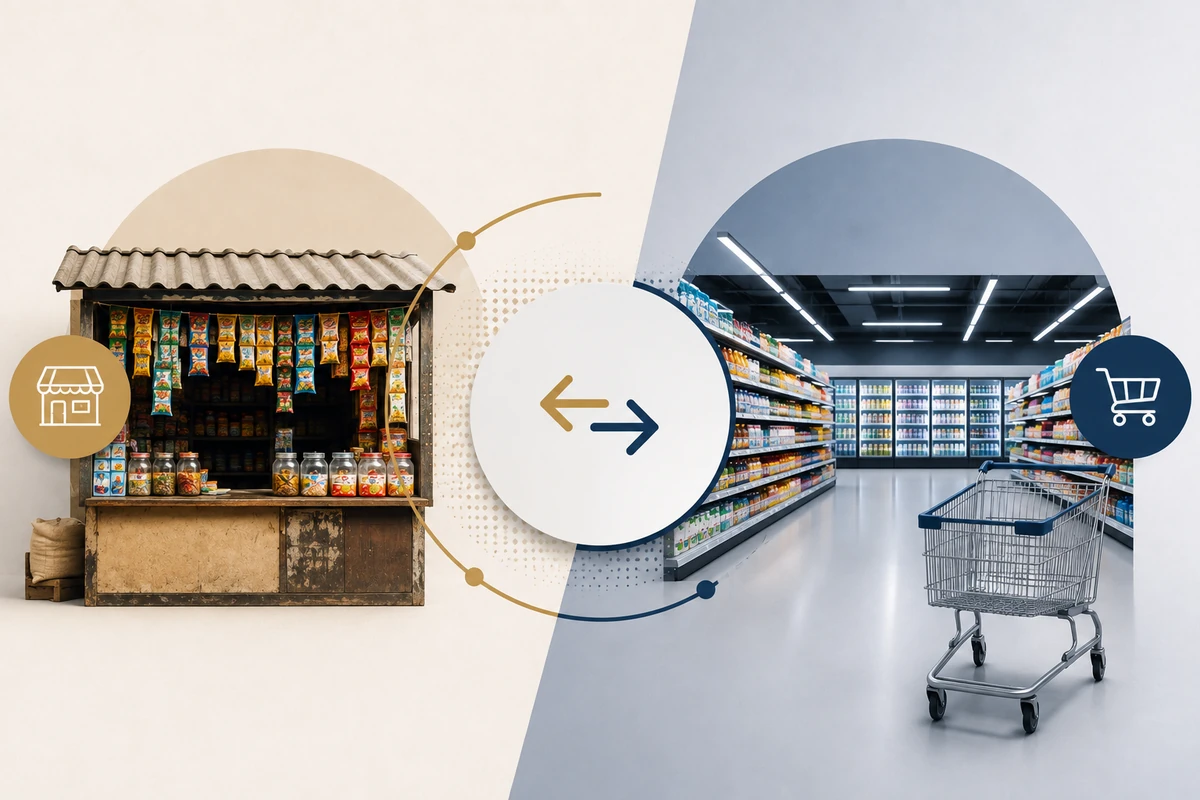
Every FMCG brand operating in India eventually has to answer the same question: how much budget goes toward general trade, and how much toward modern trade? The answer isn’t the same for every category, and treating general trade and modern trade as interchangeable channels is one of the most common, costly mistakes brands make when planning distribution strategy. The two operate on fundamentally different economics, relationships, and execution models.
Key takeaways (The TL;DR)
- General trade still accounts for the large majority of India’s retail volume, especially in Tier 2 and Tier 3 markets, despite modern trade and quick commerce growing faster in metro cities.
- Modern trade offers centralised negotiation and consistent execution across large retail chains, while general trade requires relationship-driven, distributor-led engagement across millions of independent outlets.
- Margin structures, credit terms, and shelf visibility work completely differently between the two channels, so a single distribution strategy rarely works for both without adaptation.
- Most FMCG brands need both channels running simultaneously, with general trade marketing and modern trade strategy treated as connected but distinct disciplines.
What Is General Trade?
General trade refers to India’s vast network of independent, unorganised retail outlets, kirana stores, small grocers, and neighbourhood shops that make up the traditional trade retail backbone of Indian commerce. These outlets are typically family-run, operate with limited shelf space, and depend on distributor relationships rather than direct brand negotiations for what stock they carry.
General trade distribution works through a layered system: brands sell to distributors, distributors sell to wholesalers or directly to retailers, and retailers sell to consumers. Winning shelf space in general trade depends heavily on distributor relationships, retailer incentives, and consistent field visibility rather than a single centralised negotiation.
What Is Modern Trade?
Modern trade covers organised retail: supermarkets, hypermarkets, and large retail chains like Reliance Fresh, D-Mart, and Big Bazaar-style formats that operate with centralised procurement and standardised store operations. Unlike general trade, modern trade negotiations happen at a corporate level, one agreement can determine shelf placement across hundreds of stores at once.
Modern trade marketing typically involves category management, planogram compliance, trade promotions, and listing fees, a fundamentally different commercial relationship than the distributor-led model general trade runs on.
Key Differences at a Glance
| Factor | General Trade | Modern Trade |
|---|---|---|
| Store type | Independent kirana stores, small grocers | Supermarkets, hypermarkets, organised chains |
| Negotiation structure | Distributor and retailer-led, fragmented | Centralised, corporate-level agreements |
| Market share | Majority of India’s retail volume | Smaller but growing, concentrated in metros |
| Execution model | Field force, distributor relationships, incentives | Category management, listing fees, planograms |
| Geographic reach | Deep penetration into Tier 2 and Tier 3 markets | Concentrated in metro and Tier 1 cities |
Which Channel Should a Brand Prioritise?
For most FMCG brands, general trade remains the volume driver, particularly for categories with high purchase frequency like food, personal care, and household essentials, where proximity and habit matter more than store ambience. A brand that skips general trade in favour of modern trade alone is leaving out the channel that reaches the largest share of Indian consumers by volume.
Modern trade earns its place through brand visibility, premium positioning, and the kind of controlled in-store experience that general trade can’t replicate. For newer or premium brands, modern trade listings also serve a credibility function, appearing in an organised retail chain signals quality to consumers in a way a kirana shelf sometimes can’t.
According to IBEF’s retail industry data, India’s retail sector continues to be dominated by general trade even as modern trade and ecommerce expand, which is a useful independent reference point when planning channel budget allocation rather than assuming metro-city visibility reflects national reality.
Running Both Channels Without Losing Focus
The brands that succeed across both channels treat them as connected but distinct disciplines rather than a single distribution strategy stretched across two very different systems. That usually means separate teams, or at minimum separate playbooks, for general trade distributor management and modern trade category negotiations, with shared visibility into overall sell-through so decisions in one channel account for what’s happening in the other.
Conclusion
General trade and modern trade aren’t competing strategies, they’re two different retail systems that require different relationships, different negotiation models, and different execution. Brands that treat them as one undifferentiated “retail” budget tend to underperform in both. A properly built general trade marketing and modern trade strategy accounts for these differences from the start rather than applying a single playbook to both.
Frequently Asked Questions
Is general trade still relevant given the rise of quick commerce and modern trade?
Yes. General trade still accounts for the large majority of India’s retail volume, especially outside major metro cities, and remains the primary channel through which most Indian consumers shop for everyday essentials.
What’s the biggest operational difference between general trade and modern trade?
General trade depends on distributor relationships and field-level execution across millions of independent outlets. Modern trade depends on centralised negotiations and category management that determine shelf placement across an entire retail chain at once.
Should a new FMCG brand launch in general trade or modern trade first?
It depends on the category and budget. Modern trade offers faster, more controlled initial visibility but often comes with listing fees. General trade takes longer to build but reaches a far larger base of everyday shoppers once distributor relationships are established.
Do general trade and modern trade require different pricing strategies?
Often yes. Modern trade typically involves listing fees, trade promotions, and margin structures negotiated at a chain level, while general trade pricing needs to account for distributor and retailer margins layered through a longer supply chain.
Can one team manage both general trade and modern trade effectively?
It’s possible with the right structure, but most brands see better results with separate playbooks, and often separate specialists, for each channel, connected through shared reporting rather than run as one undifferentiated retail strategy.