
Borécha
Functional Beverages
Quick-Commerce Marketing
+156.8% Overall Sales — January to September 2026
Read Case Study


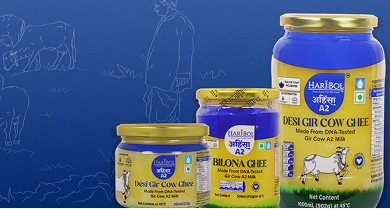

HariBol is an ethical, farm-to-consumer food brand built on rural empowerment, sustainability, transparency, and cruelty-free practices. By connecting over 2,000 farmers directly with consumers across India, HariBol combines traditional dairy and farming practices with AI and IoT-enabled traceability to build a transparent, sustainable food ecosystem. Its product portfolio spans dairy, oils, honey, and flour.
Before partnering with AKOI, HariBol was set a 12-month target for overall sales (figures confidential) while working towards a T-ACoS target of 15%. During the engagement, overall sales passed that target in March 2026, up +1,257.4% on March 2025, while T-ACoS improved significantly from 26.16% in March 2025 to 21.84% in March 2026, and subsequently moved below the 15% target by July 2026.
| Metric | March 2025 Values | March 2026 Values | Growth/Change |
|---|---|---|---|
| Overall Sales | Confidential | Confidential | ↑ +1,257.4% |
| Organic Sales | Confidential | Confidential | ↑ +1,006.0% |
| Ad Spends | Confidential | Confidential | ↑ +1,033.1% |
| Ad Sales | Confidential | Confidential | ↑ +1,626.7% |
| Ad ROAS | 1.55x | 2.36x | ↑ +52.4% |
| T-ROAS | 3.82x | 4.58x | ↑ +19.8% |
| Ad ACoS | 64.59% | 42.39% | ↓ −34.4% |
| T-ACoS | 26.16% | 21.84% | ↓ −16.5% |
Between March 2025 and March 2026, overall sales grew +1,257.4%, with organic sales up +1,006.0% and ad sales up +1,626.7%. Marketing efficiency improved considerably over the same period: T-ROAS rose from 3.82x in March 2025 to 4.58x in March 2026, reaching 6.44x by July 2026, while T-ACoS declined from 26.16% in March 2025 to 21.84% in March 2026 and 15.52% by July 2026.
HariBol began the engagement live on five quick-commerce platforms: Blinkit, Swiggy Instamart, Zepto, BigBasket, and Amazon Now. Before scaling advertising spend, the team focused on getting the fundamentals right, since these are the levers that determine whether ad spend can convert into sustainable growth.
Identifying which pack sizes and formats consumers actually preferred (1L vs. 250ml vs. 500ml; sachets vs. tins vs. glass bottles).
In quick commerce, sales are won or lost on whether a product is stocked, discoverable, and deliverable within the platform’s delivery window, at the right place and time.
Used as a lever to unlock demand once availability was fixed.
Content and imagery were audited and improved, and brand stores were rebuilt to platform standard.
Focused on scaling product discoverability and awareness.
With these fundamentals addressed, the team moved into platform-specific strategy, since quick commerce and eCommerce platforms each called for a distinct approach.

Zepto’s inventory is split across Super Stores and Dark Stores. Super Stores cover around 20% of a city’s stores and mainly serve as a test-and-learn phase, with limited demand and visibility. Dark Stores, in contrast, offer stronger visibility and sales potential by placing products closer to high-demand areas and relevant pincodes.
To scale sales and market share, the team reviewed HariBol’s store placement with Zepto and identified that most products were in Super Stores. Key SKUs were shifted to Dark Stores, with logistics fees incurred per SKU, expanding product coverage and improving sales potential.
Zepto also required a committed investment, which contributed to a significant sales increase in July 2025. Combined with the improved visibility from the Super Store to Dark Store transition, this became a key driver of HariBol’s sales growth. A greater focus on Search campaigns further improved product visibility and traffic.

In June 2025, revenue fell 16.8% despite a 232% rise in ad spend, indicating that the challenge went beyond advertising performance. Discussions with the platform team and patterns across other brands pointed to limited product visibility and reach, leading to efforts to expand availability across relevant delivery areas.
With visibility improved, the focus shifted to campaign optimisation and advertising efficiency. This helped reduce CPC and support stronger sales growth, with sales rising 60% in November.
By December 2025, every rupee invested was generating about 2.9x in sales, supported by improved visibility, efficient advertising, and targeted commercial interventions. A pricing correction in December added further momentum, with sales increasing 18.5% in January 2026.

Blinkit was HariBol’s top-contributing platform from the start of the engagement. New brands begin at Level 0 with a 30-day evaluation, progressing through additional warehouse locations and levels based on run rate, with Level 4 providing full pan-India visibility. HariBol reached Level 4.
A working session with Blinkit focused on pricing, awareness, and the sales dip between April and June 2025, driven by high stock levels and a mismatch in product focus. Limited consumer awareness of bilona ghee led to a shift in focus toward stronger demand drivers.
Analysis showed that 500ml and 1L packs generated most sales, which was validated through Tier 1 and Tier 2 consumer behaviour. Availability of these sizes was increased along with pincode coverage, improving visibility. Ongoing testing also helped identify the most effective ad formats for each pack size.
The changes contributed to a 79.24% sales increase in July 2025, driven mainly by improved awareness and pricing. From May 2025 to July 2026, overall sales grew 276%, organic sales 292%, and Ad ROAS 23%. Sales peaked in September 2025 at over 400% above the May 2025 baseline.

BigBasket splits its locations into A, B, C, and D pods, with C and D pods together making up only around 30% of total location coverage. Seeing the potential for greater visibility and reach, the team worked with BigBasket to move HariBol’s products from the lower-coverage C and D pods to the higher-coverage A and B pods in March 2026. Joining the BigBasket Brand Acceleration Program further improved product visibility and opened up additional growth opportunities. Well-structured campaigns and focused keyword targeting also helped reach the right shoppers and drive conversions. Together, these steps helped grow sales by +175% from February 2026 to March 2026.

HariBol launched on Amazon in September 2025, with sales beginning to scale from January 2026. Early performance was held back by delivery-timeline issues under a non-FBA fulfilment model. Moving to Fulfilled-by-Amazon (FBA) reduced delivery times and pricing, increased supply, and expanded warehouse coverage, directly unlocking growth.
A consistent playbook was layered on top of the platform-specific work described above.
Search campaigns consistently drove around 70% of traffic across platforms, supported by category and display campaigns.
Between September and November 2025, spanning Krishna Janmashtami, Deepavali, and Dasara, the team pushed spends more aggressively alongside strong consumer offers, making this one of the strongest-performing periods of the year.
Active management of product reviews supported conversion and sales performance across platforms.
Achieved pan-India visibility.
Diagnosed and corrected pod and placement issues on Zepto, Swiggy Instamart, and BigBasket, turning what initially looked like advertising problems into solved reach and distribution problems.

Partnering with AKOI has been a great experience for our quick-commerce business. Their strong relationships and understanding of each platform have made it much easier for us to navigate the ecosystem, execute faster, and expand our presence across multiple platforms. Since partnering with them, we have seen consistent growth and stronger performance across our online channels. Their proactive approach, platform expertise, and commitment to our business have made them a valuable partner, and we look forward to growing together and achieving many more milestones.
Functional Beverages
Quick-Commerce Marketing
+156.8% Overall Sales — January to September 2026
Read Case Study
Premium Chocolate
Quick-Commerce Marketing
+1,101% Overall Sales — November 2025 to February 2026
Read Case Study